Human Rights Now Human Rights Now
The Amnesty International USA Web LogVisit us
  Subscribe

Archive for the ‘Americas’ Category

Breaking News: Deal Emerges in Honduran Coup Crisis

Friday, October 30th, 2009

Ousted Honduran President Manuel Zelaya and de facto Honduran leader Roberto Micheletti reached an agreement on Thursday that involves sharing power for the remaining of Zelaya’s term. More from Democracy Now!:

…Roberto Micheletti, said the agreement would create a power-sharing government and require both sides to recognise the result of the November 29th presidential elections. It would also create a truth commission to investigate the events of the past few months.

Micheletti and Zelaya held talks separately on Thursday with Tom Shannon, the US assistant secretary of state, and Dan Restrepo, Washington’s special assistant for Western Hemisphere affairs. As the negotiations were underway Thursday, a rally by hundreds of pro-Zelaya protesters in Tegucigalpa was broken up by police who fired tear gas.

A few questions still remain about the agreement — Congress has to approve the agreement and some experts are worried about continued bitterness from Zelaya supporters who do not want a power sharing government.

I think the most important part of the deal is that it establishes a Truth Commission to look into abuses (on both sides) committed during the civil unrest during the days of the coup. Though details of the commission are not laid out yet, it is a very important first step to ending this crisis appropriately.

What do you think of the deal?

Who Really Killed Brad Will?

Monday, October 26th, 2009
Brad Will ©AI

Brad Will ©AI

This week is the anniversary of the death of Brad Will, a US video journalist who was shot and killed in Mexico on October 27, 2006. When he was killed, Bradley Roland Will was in Oaxaca City, in southern Mexico, filming a clash between members of a local protest movement (Asamblea Popular del Pueblo de Oaxaca, APPO) and supporters and officials of the local governing party. Three years later, Amnesty International believes that the truth about Brad Will’s death has still not come out. Juan Manuel Martínez, an APPO sympathizer, has been detained pending trial since October 2008 for Will’s murder. However, experts from Physicians for Human Rights and the National Human Rights Commission have concluded that Will was not shot at close range, and Martinez is said to have been standing right next to him when the shooting happened. Amnesty International believes the evidence against Martinez is flawed and he is a being used as a scapegoat.

The tragedy and injustice of Brad Will’s death and Juan Manuel Martínez’s unfounded prosecution are part of the failure to investigate and hold to account those responsible for widespread human rights violations committed in Oaxaca in 2006 and 2007.

(more…)

Getting (even more) Scary in Honduras

Thursday, October 8th, 2009

If you’ve been keeping up with the news in Honduras, you know about the crackdown on protesters, crackdown on media outlets, and slow diplomatic talks.

Supporters of ousted Honduras President Manuel Zelaya sit in front of Honduran army soldiers, 3 July 2009  © AP/PA Photo/Dario Lopez-Mills

Supporters of ousted Honduras President Manuel Zelaya sit in front of Honduran army soldiers, 3 July 2009 © AP/PA Photo/Dario Lopez-Mills

You also might know it’s a pretty emotional issue for Hondurans, many of whom stand completely with Zelaya or the de facto government. Just read the comments on my last blog and you’ll get the idea.

But did you know about an executive decree that bans all public meetings and gives incredible power to police? Yep, it’s true. According to a new AI story:

Honduran de facto president Roberto Micheletti must rescind a decree that provides sweeping new powers of detention to the police, bans all public meetings and imposes a 45 day curfew, Amnesty International said on Tuesday.

“Honduras risks spiralling into a state of lawlessness, where police and military act with no regard for human rights or the rule of law,” said Susan Lee, Americas Director at Amnesty International. Roberto Micheletti must urgently rescind the decree and send clear instructions to the security forces to respect human rights in all circumstances and at all times.”

Since AI ran this story, Micheletti has vowed to reverse the decree — but not surprisingly has been slow to follow through.

From the beginning of the crisis in Honduras, Amnesty International has tried to make sense of the issue through a human rights lens rather than taking political sides — calling out human rights violations and getting the word out about unlawful abuse and detentions. Even though Amnesty is producing thoughtful research and news stories about human rights abuses in Honduras, more has to be done.

With rumors of civil war among some social organization spreading and the diplomatic talks stalling, now is time for you to take action to help end this crisis and restore human rights to the Honduran people!

Human Rights Flashpoints – September 22, 2009

Tuesday, September 22nd, 2009

HONDURAS – Surprise Return of Ousted President Sparks Protests
Following the surprise return of ousted President Manuel Zelaya on Monday, thousands of protestors gathered in support outside of the Brazilian embassy where Zelaya is currently seeking refuge, defying a city-wide curfew. As reported by the AP, a 26-hour curfew in the capital began Monday afternoon, with the international airports closed and road blocks erected to prevent future protests. According to the BBC, police have surrounded the Embassy, wearing riot gear and firing tear gas into the crowd in order to dissolve the protesters.

De facto President Roberto Micheletti, initially unaware of Zelaya’s return, has now asked the Brazilian Embassy to hand over Zelaya to stand trial on 18 counts of corruption and treason. However, both the US and the EU have urged both leaders to remain calm and encourage respective supporters not to resort to violence.

With the upcoming elections on November 29th just a little over two months away, the possibility for increasing violence in the country continues to exist. A recent Amnesty International Report (pdf) stated:

Concerns include the increasingly disproportionate and excessive use of force being used by the police and military to repress legitimate and peaceful protests across the country. Female protestors are particularly vulnerable and some women and girls taking part in the demonstrations are reportedly suffering gender based violence and abuse at the hands of police officers.

The de facto government now faces pressure to enter into talks with the ousted President, which could lead to further human rights violations of supporters and crack downs on media as previously documented by AI and the Inter-American Human Rights Commission reports. Although some have argued that Zelaya’s presence may be helpful to resolving the current governing dispute, analysts warn that the president’s presence in the city is likely to move the conflict into the streets.

Must Reads

Overheard

It’s imperative that dialogue begin … (that) there be a channel of communication between President Zelaya and the de facto regime in Honduras, It’s also imperative that the return of President Zelaya does not lead to any conflict or violence but instead that everyone act in a peaceful way to try to find some common ground - Hillary Clinton, US Secretary of State

I was traveling for around 15 hours using different routes and different methods of transport to arrive here and call for dialogue, which is my role as the elected president of Honduras – Honduran President Manuel Zelaya

Upcoming

  • September 22: Amnesty International launches its new report on maternal mortality in Sierra Leone in Freetown: Out of Reach: The cost of maternal health in Sierra Leone (pdf)
  • September 22: President Obama meets with Israeli Prime Minister Benjamin Netanyahu and Palestinian President Mahmoud Abbas during the UN General Assembly in New York.
  • September 22: Save Darfur Coalition Darfur/Darfur opening event in midtown Manhattan.
  • September 23: Transparency International launches its Global Corruption Report 2009: Corruption and the Private Sector.
  • September 23-26 & 28-30: UN General Assembly general debate.
  • September 23: Iranian President Mahmoud Ahmadinejad addresses the UN General Assembly.
  • September 24: Commemoration of the 60th anniversary of the UN Relief and Works Agency for Palestine Refugees in the Near East (UNRWA).
  • September 24-25: G20 Summit in Pittsburgh, PA.

Jennifer Ferreri contributed to this post.

Human Rights Flashpoints is a weekly column about countries at risk of escalating human rights violations and is brought to you by AIUSA’s Crisis Prevention and Response team.

Former POC and Environmental Defender Felipe Arreaga Dies at Age 60

Monday, September 21st, 2009
Felipe Arreaga in Guerrero. © Monica Campbell

Felipe Arreaga in Guerrero. © Monica Campbell

Amnesty International is sad to learn of the death of Felipe Arreaga, former environmental activist from Petatlán, Guerrero, in Mexico. Arreaga, founder of the Peasant Environmentalist Organization of the Sierra de Petatlán (Organización Campesina Ecologista de la Sierra de Petatlán – OCESP), died last Wednesday morning September 16th, after being hit by a mini bus while he travelled along the national highway, connecting Acapulco and Zihuatanejo.

In 2004, Amnesty International adopted Felipe Arreaga as a prisoner of conscience, issuing Urgent Actions and initiating other work on his behalf. On November 3, 2004, Felipe was detained and unjustly charged for a 1998 murder. During his detention lawyers proved that he was not responsible for the murder, and a witness admitted that he was forced to make a statement against Felipe. After 10 months, with the support of Amnesty International activists around the world, he was released and finally returned home. You can read more about Felipe and his work in this 2005 profile that appeared in Amnesty International Magazine.

Our most heartfelt condolences go out to Felipe’s wife, Celsa, and his friends and family. Felipe’s peaceful struggle to prevent excessive logging of local forests will always be remembered. Felipe Arreaga’s detention is a reminder to all of the unjust detentions occurring right now in Mexico and many other countries, and of the difference that human rights activism can make in the lives of individuals. Without the support of Amnesty and letters written by individuals, Felipe may not have been released. Thank you to all who supported Felipe Arreaga—his environmental activism, his dedication, and his strength of spirit will not be forgotten.

(more…)

Indigenous Mother of Six Released from Prison in Mexico

Thursday, September 17th, 2009

Prisoner of conscience Jacinta Francisco Marcial, a mother of six who was falsely accused in 2006 of kidnapping six federal agents has been released after serving three years in prison in Mexico. Amnesty pressed for her release after concluding no evidence existed against her and she had been arrested, tried and convicted because she was poor and of indigenous heritage.

Her release raises serious questions about the reliability of the entire prosecution case and highlights clear failings in the investigation. Amnesty International is calling for a full review into her unfounded prosecution and for her to receive full compensation for unfair and wrongful imprisonment.

You can read the full press release here. Learn about Jacinta’s ordeal in her own words, in this interview conducted this past June 29th:

Update: Leonard Peltier Denied Parole

Monday, August 24th, 2009

To our deep disappointment, Leonard Peltier was denied parole on Friday, nearly a month after his July 28 parole hearing. In addition to our online action, Amnesty International had sent an open letter to the parole board in early July urging that Peltier be granted parole, and Amnesty continues to call for his immediate release on parole. You can read more about Leonard’s case in this blog post, and in the full AI press relase. The US Department of Justice also issued a lengthy press release on Friday.

The Media Hype May Be Over, But There Is Still A Crisis In Honduras

Wednesday, August 19th, 2009

Amnesty International issued a report today about the ongoing crisis in Honduras following the coup d’etat which took place June 28. Many press outlets have covered the report and accompanying press release which comes at a crucial time as the crisis in Honduras must be kept in the attention of the mainstream media and general public.

AI’s main concerns with the crisis as cited in the report are:

Two of the ten students who took part in the peaceful march on 30 July 2009. The imprint of the police batons is clearly visible on both students. Amnesty International

Two of the ten students who took part in the peaceful march on 30 July 2009. The imprint of the police batons is clearly visible on both students. Amnesty International

  • Excessive use of force
  • Gender-based violence
  • Use of military in civilian law enforcement
  • Freedom of expression
  • Curfew measures
  • Safety of human rights defenders

I’ll let the words of Hondurans speak for themselves to end this post, as their words are much more powerful than mine:

“We were demonstrating peacefully. Suddenly, the
police came towards us, and I started running. They
grabbed me and shouted “why do you (all) support
Zelaya’s government? Whether it’s by choice or by
force, you have to be with this government”. They
beat me. I have not yet been informed as to why I
am here detained.”

[“Fernando”, 52 year-old teacher, at a police station in Tegucigalpa, Honduras, 30 July 2009]

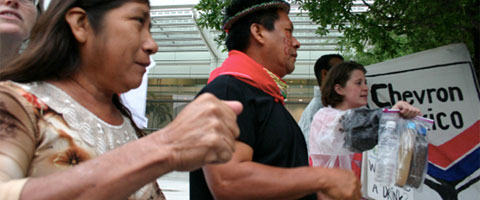
Sleeper Hits of the Summer – Part 1: The Curious Case of 30,000 Indigenous People vs. Chevron

Thursday, August 13th, 2009

By Anna Phelan, Amnesty International USA’s Business & Economic Relations Group

Among my picks for sleeper hits of the summer, is a powerful documentary film called Crude: The Real Price of Oil. The film is described as a real-life high stakes legal drama, set against a backdrop of the environmental movement, global politics, celebrity activism, human rights advocacy, the media, multinational corporate power, and rapidly-disappearing indigenous cultures. For the most part, the main characters aren’t actors… well, I mean Chevron’s invested a lot of money and time in their web of lies, so maybe they’ve been taking acting lessons. And so far, Chevron’s signature method of acting has been to deny responsibility and shift the blame for contaminated soil and groundwater in the communities of the Ecuadorian Amazon.

:: Learn more about the history of oil in the Amazon and Amnesty’s work ::

On Sunday, the United Nations Secretary-General Ban Ki-moon spoke of how indigenous communities suffer disproportionately from low health standards linked to poverty, malnutrition, environmental contamination and inadequate healthcare marking the International Day of the World’s Indigenous People. The hardship and discrimination faced by indigenous peoples has a lot to do with the fact that they are often excluded from decision-making processes – by both governments and corporations. In her Op-Ed piece, Navanethem Pillay, U.N. High Commissioner for Human Rights, called for more than a symbolic celebration saying, after centuries of repression, they need comprehensive tools to defend their human rights, their way of life, and their aspirations.

And that’s what makes the case against Chevron a compelling story for film – not unlike the Doe v. Unocal lawsuit or, more recently, Wiwa v. Royal Dutch Shell. Indigenous peoples are gaining access to the legal system to challenge governments and transnational companies and defend their human rights. You might not know their names, but the 30,000 indigenous people who filed suit against Texaco (now Chevron) in 1993 are more than Extras. They are the real-life protagonists.

Sleeper hits are made by word of mouth recommendations. Crude: The Real Price of Oil opens to larger audiences on 09/09/09. Take action now to show your support of human rights for the indigenous communities of Amazon’s Ecuador.

Crude: The Real Price of Oil Trailer

Unlock the Camps in Sri Lanka!

Monday, August 10th, 2009

Hundreds of thousands of people displaced by the recent war in North Eastern Sri Lanka live now in camps and are being denied basic human rights. In response to this crisis we just launched the Unlock the Camps campaign, in which we urge the Sri Lankan government to allow freedom of movement and the installment of a civilian administration of the military run internment camps. We further call on the Government of India to monitor the aid pledged to the Sri Lankan government. As part of the Unlock the Camps campaign we have developed a Facebook Crisis Application, and produced a new Briefing Paper.

Two months after the end of the fighting, the Sri Lankan authorities are still not addressing properly the needs of the newly displaced. The camps are overcrowded and unsanitary. In addition, these are effectively detention camps. They are run by the military and the camp residents are prevented from leaving them; they are denied basic legal safeguards. The government’s claim that it needs to hold people to carry out screening is not a justifiable reason to detain civilians including entire families, the elderly and children, for an indefinite period.

Displaced people have even been prevented from talking to aid workers. With no independent monitors able to freely visit the camps, many people are unprotected and at risk from enforced disappearances, abductions, arbitrary arrest and sexual violence.

According to government figures, the fighting between the Sri Lankan army and the Liberation Tigers of Tamil Eelam (LTTE) displaced over 409,000 people. At least 280,000 are displaced from areas previously under LTTE control. A dramatic influx of people fleeing the fighting and crossing to government controlled areas took place from March 2009. The displaced people, including at least 50,000 children, are being accommodated in 41 camps spread over four districts. The majority of the displaced are in Vavuniya District where Menik Farm is the biggest camp.

When United Nations Secretary General Ban Ki-moon visited some of the camps in May, he said:

I have travelled around the world and visited similar places, but this is by far the most appalling scene I have seen.

While some progress had been made on providing basic needs, much still needs to be done on the right to health, food, water, family reunion and access to relatives. We continue to urge the government of Sri Lanka:

  • to end restrictions on liberty and freedom of movement
  • to ensure that camps are of a truly civilian nature and administered by civilian authorities, rather than under military supervisions
  • give immediate and full access to national and international organizations and observers, including aid agencies, in order to monitor the situation and provide a safeguard against human rights violations.

Trapped in de-facto detention camps

The Sri Lankan government said on 21 May that the displaced will be resettled in 180 days. But very few have so far been allowed to return to their homes or to join friends or family elsewhere, and people remaining in the camps are not at liberty to leave camp premises. The Sri Lankan government must end its policy of forcibly confining people to camps, which amounts to arbitrary detention.  The Sri Lankan government must allow persons who require temporary shelter in these facilities to come and go freely.

With assistance and support from the international community and the involvement of displaced people themselves, the Sri Lankan government must set up clear benchmarks and timelines to ensure that displaced people can safely return home or find other durable solutions (such as relocation) as soon as possible.

 
Search this blog