Afghan Women to NATO: Don’t Bargain Our Rights Away

afghan women at school

Afghan teacher Meher Afroza with her students at an Islamic school in Kabul. Under the Taliban, few girls attended school. Today 3 million girls go to school, and 20 percent of university of graduates are women. (Photo: ADEK BERRY/AFP/Getty Images)

World leaders, dignitaries and reporters will convene in Chicago next week for the 2012 NATO summit, and among the urgent questions they will consider is that of Afghanistan’s future after the 2014 withdrawal of U.S. and allied troops.

Yet Afghanistan’s female leaders were denied a place at the table for these critical discussions—despite Secretary of State Hillary Clinton’s promise that the United States would not forsake the rights of Afghan women.

Indeed, recent developments signal that the significant but tenuous gains Afghan women have made over the past decade are mere bargaining chips in negotiations between U.S., Afghan and Taliban leaders seeking to expedite the transition to Afghan rule. Afghan President Hamid Karzai has proposed a program of “reintegration and reconciliation” with the Taliban that holds grim implications for women and girls, and in March he briefly endorsed an edict issued by a council of clerics that would allow husbands to beat their wives in certain situations and encourage gender segregation in workplaces and schools.

SEE THE REST OF THIS POST

Killing The Innocent With Indifference

Carlos-De-Luna

Carlos DeLuna was executed by the state of Texas in 1989. A new study by Columbia University could prove his innocence.

The USA has almost certainly executed innocent men in the so called “modern” era of capital punishment, since the death penalty was reinstated in 1976. One of them may have been Carlos DeLuna, who was put to death in Texas in 1989 for the killing of gas station attendant Wanda Lopez in Corpus Christi.

Today, a comprehensive report and website by James Liebman and a team of students in the Columbia University Human Rights Law Review makes a compelling case for DeLuna’s innocence.

To explain how this wrongful conviction and execution could have happened Liebman et al. point to the

“failure of lawyers on the defense as well as the prosecution side to have the curiosity and gumption to look just an inch or two below the surface.”

SEE THE REST OF THIS POST

Russia: Where a Punk Rock Performance Could Land You in Prison

pussy riot

"Pussy Riot" (Image via Wikipedia)

Three young women in Russia may spend seven years in prison for “hooliganism” after a flash punk rock performance at a Moscow church that criticized President Vladimir Putin.

Nadezhda Tolokonnikova, Maria Alekhina and Ekaterina Samutsevich, alleged members of the controversial band Pussy Riot, were arrested in March 2012 and are being held in pre-trial detention following the politically-fueled performance at Moscow’s famed Cathedral of Christ the Saviour.

Egyptian air is good for the lungs / Do Tahrir on Red Square!

Pussy Riot lyric

While the three women deny any involvement in the protest (band members cover their faces with balaclavas) even if they took part, the severity of the response by Russian authorities is not justifiable to the peaceful – even if to many, offensive – expression of their political beliefs.

Pussy Riot is a Moscow-based anonymous feminist band that, for the last year and a half, has played unauthorized “flash performances” to protest government policies (watch them in action here).  Pussy Riot’s members use their right to freedom of speech – through music – to shed light on what they perceive to be a corrupt government. In an interview with the Guardian, band member “Garadzha” explains:
SEE THE REST OF THIS POST

Battle for the Future of India

Jagatsinghpur district in the eastern Indian state of Orissa is a poor rural place. But it is at the crucible of a battle for the future of India.

In 2005, state and national governments approved a massive steel plant here, and the South Korean steel company POSCO prepared to sink $12 billion into the project. Yet from the beginning, local residents objected to this top-down development, which would push them from their farmland and fishing spots, depriving them of their homes, land, and livelihoods (if history is any guide, they were likely to end up in distant urban slums).

After hundreds of villagers were forcibly evicted last summer opposition stiffened locally, across India and around the world. By late 2011, the Orissa government began resorting to jailing peaceful protest leaders on false charges. First it was Abhay Sahoo – who had also been jailed for 10 months in 2008-9. Then, it was Narayan Reddy.

SEE THE REST OF THIS POST

The Execution of Michael Selsor

Michael Selsor

Michael Selsor

Oklahoma carries out more executions per capita than any other state in the USA (though things might slow down as the state is currently down to its last dose of pentobarbital, the anesthetic in its lethal injection cocktail).

In September 2010, Al Jazeera reporter Josh Rushing put together a video piece on the Oklahoma and U.S. death penalties. Now, he has supplemented that with his interview of Michael Selsor, who was first sent to Oklahoma’s death row in 1976, and a blow-by-blow description of Selsor’s execution on May 1, 2012 for the 1975 killing of convenience store clerk Clayton Chandler in Tulsa.

The interview with Selsor (which took place back in 2010 and was the only one he ever gave) is particularly interesting and reveals a man who was remorseful, reflective, somewhat resigned but also prideful.  He was sorry for his crime, but never reached out to the victim’s daughter:

“And really if I could say look I’m sorry for what I’ve done, I’m sorry I killed your dad, what the hell would that mean to her?”

SEE THE REST OF THIS POST

Marriage Equality: It’s About Human Rights, Not States’ Rights

Maria Vargas and Maira Garcia wait on line to get married at the City Clerk's office in Brooklyn, New York, on July 24, 2011, the first day gay couples were allowed to legally marry in New York state. (Mario Tama/Getty Images)

President Obama’s courageous statement today in support of marriage equality was a boon to the human rights movement. The president’s announcement was especially heartening following the news yesterday that North Carolina passed a ban on marriage for same-sex couples and other partnership agreements and that Republican state legislators effectively blocked the Colorado Civil Union Act from going to a vote.

The president’s statement is also an important act of global human rights leadership that will no doubt lend hope to lesbian, gay bisexual and transgender (LGBT) people in countries like Saudi Arabia, Uganda and Cameroon who face threats of execution, torture, imprisonment and persecution for their sexual orientation.

SEE THE REST OF THIS POST
Exploitation of Nepal’s Migrant Workers

Nepal migrant workers

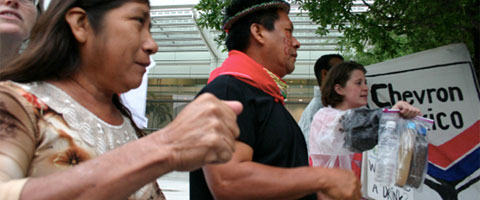
Families of migrant workers in Morang district, Nepal, 2011, who were interviewed by Amnesty International.

 “Migrant workers from Nepal and other countries are like cattle in Kuwait.  Actually, cattle are probably more expensive than migrant workers there.  No one cares whether we die or are killed. Our lives have no value.” –N.R., domestic worker from Ilam district, Nepal

Anyone who has waited for a flight at Kathmandu, Nepal’s international airport has seen the large groups of men and women quietly lining up to board flights for Qatar or Malaysia, many appearing nervous, clutching only their papers or a small bag of belongings.

But the men and women boarding these flights have reason to be nervous. While some Nepalese migrant workers arrive in the destination country and earn decent wages, others end up in forced labor or exploitative conditions.

These are some of the estimated 25,000 people a month who leave Nepal for work abroad to escape poverty and unemployment at home and to send remittances back to their families in Nepal.

SEE THE REST OF THIS POST

Violence Against Armenian Women is a Crime, Not a Tradition

Armenian woman protests

Will Armenia step up protections for women? (Photo KAREN MINASYAN/AFP/Getty Images)

The smallest yet probably oldest of the successive Soviet nations, Armenia prides itself for its ancient traditions. In his International Women’s Day statement, President Serge Sarkissian wishes women “happiness, luck, and healthy and strong families,” commending the preservation of women’s “traditional role.”

Does the latter include being a victim of violence? The Armenian government’s very poor record on combating widespread violence against women may suggest so.

Armenia is the only country among its Council of Europe neighbors without legislation criminalizing domestic violence. Armenia’s government has been arguing that it will pass comprehensive legislation once the Council of Europe finalizes its convention on the issue. It’s been nearly a year since the Council of Europe convention on preventing and combating violence against women and domestic violence opened for signatures, yet Armenia hasn’t ratified it (see the interactive map of countries that have).

SEE THE REST OF THIS POST

The Elephant in the Courtroom

No matter how hard the Military Commissions try they can’t escape the elephant in the courtroom. The five defendants in the 9/11 case were tortured by the CIA and the government is tying itself in knots trying to work around this fact.

In his press conference on the eve of the arraignment the Chief Prosecutor, General Mark Martens, tried to address this issue:

“Some have said that any attempt to seek accountability within the Military Commissions system must inevitably be tainted by torture… we acknowledge your skepticism, but we also say that the law prohibits the use of any statement obtained as a result of torture or cruel, inhuman or degrading treatment, and we will implement the law.”

Of course the law also requires the state to investigate allegations of torture – yet in the case of the five defendants being arraigned this hasn’t happened. That might explain some of our skepticism.
SEE THE REST OF THIS POST

Inside Syria’s crackdown: ‘I Found My Boys Burning in the Street’

Syrian refugee family

A Syrian family sits around a fire resting in the northewestern village of Janoudia, in Idlib province, as they wait to be helped by rebels of the Free Syrian Army to cross the Syrian border with neighbouring Turkey. (Giorgos Moutafis/AFP/Getty Images)

Donatella Rovera, Amnesty International’s senior crisis adviser, was in Syria’s Idlib province for 10 days at the end of April. Here she reports some of the first-hand accounts of the brutal crackdown by the Syrian regime against its people:

“Soldiers came to our home and took my son. Later, as I was peering out of the window I saw soldiers line up eight young men standing facing the wall with their hands tied at the back and shoot them. Then they put the bodies in the back of a pick-up truck and left. I don’t know if the men were all dead or injured. At that point I did not know that one of the men was my son. His body was found with other bodies at a school not too far from our home.”

SEE THE REST OF THIS POST