Justice For Syria: How Satellites Can Help

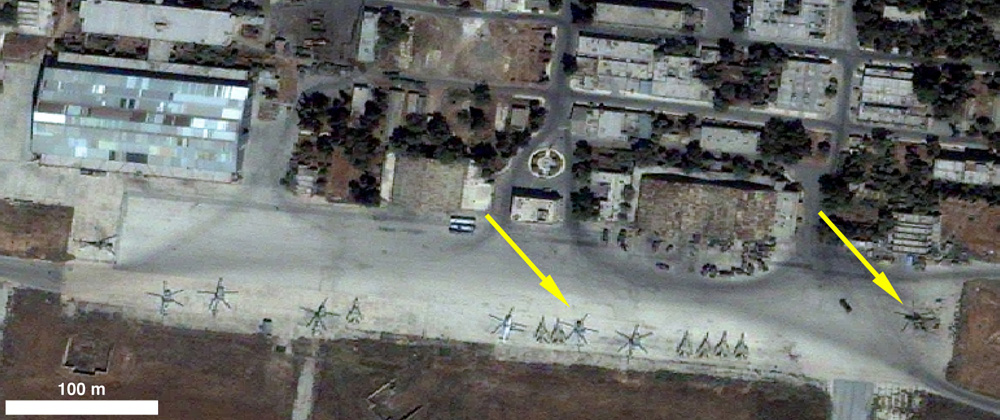
helicopters aleppo syria

Suspected attack helicopters at Aleppo airport. (c) 2012 GeoEye, produced by AAAS

Newly released satellite images of Aleppo show a highly militarized city, with dozens of roadblocks throughout the city and military vehicles operating in its streets. We used satellite images a couple of months ago to ring the alarm over the increased risk of turning a highly populated area, such as Aleppo, into a battlefield. Our warning turned out to be justified. The weeks that followed saw indiscriminate attacks that have killed and injured scores of civilians in Aleppo and elsewhere in northern Syria.

Today’s analysis, released by the American Association for the Advancement of Science and based on imagery from August 9 and 23, provides a detailed follow up to our initial assessment from earlier in July. As the conflict in Syria escalates, the increased deployment of battlefield equipment and tactics in urban areas emerge in satellite images. Here are some of the key findings of the new analysis:
SEE THE REST OF THIS POST

I Refuse To Forget You: Supporting The World’s Disappeared

Enforced disappearances – the practice by states or governments to detain (or worse) citizens and keep their families in the dark about their fate – have been a human rights problem in Syria for decades. However, Syrian authorities’ heavy handed response to the popular uprising, characterized by an utter disregard for human rights, has led to a dramatic rise in cases of enforced disappearance. This issue and its long-standing impact on families and loved ones, are widely underreported.

Much of the Syrian government’s strategy relies on us simply forgetting about political detainees. In the case of enforced disappearances, this strategy is taken to next level: putting political opponents and activists completely outside the law, and very literally, outside of our memories. Victims are disappeared without a trace – with governments careful not to leave behind any trail of official records or information, deepening families’ despair and banking on to us forget. Well, I refuse to play by their rules.

Today, on the International Day for the Victims of Enforced Disappearances, we are shining a light on some individuals that the Syrian government – as well as other repressive regimes around the globe – want you to forget. We are tracking several cases using Eyes on Syria , and I want to provide you with an opportunity to join me in countering the Syrian governments’ attempt to make people disappear.

SEE THE REST OF THIS POST

“I Never Thought It Was The Last Time I Would See My Family”

Ahmad Kayali

Ahmad Kayali was killed along with this mother, two sisters, uncle and cousin when his home in Aleppo was destroyed by an airstrike by the Syrian army.

“When I went to work, I never thought that it was the last time I would see my family. I lost all that was dearest to me, my children, my wife, my brother, my cousins, everybody.”

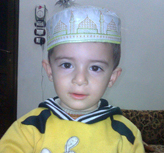
This statement by the husband of Asma Kayali, 25, sums up the situation civilians in Aleppo. Asma was killed with her three children – her daughters Kawthar and Fatima, aged nine and seven, and her four-year-old son Ahmad – when her home was bombed to dust by an air strike on August 6. In total, 10 members of the Kayali family – seven of them children – were killed in that attack, which is emblematic of Syria’s spiraling human rights crisis.

Today, the assault on Aleppo continues unabated, and more civilians are at risks to get killed by indiscriminate attacks carried out by government forces.

Unfortunately, my recent concerns about the specter of an imminent deployment of heavy weaponry in the densely populated environment of Aleppo have become a reality (also check out these pictures of urban warfare from a Reuters photographer). The result is a mounting number of war crimes piling onto an already extensive list of atrocities committed in Syria.

SEE THE REST OF THIS POST

UN Reveals Further Evidence of Atrocities in Syria

In its newest report on Syria, the UN Commission of Inquiry today revealed further evidence that the government and associated Shabbiha militias have committed crimes against humanity and war crimes over the last few months. In addition, the report found that armed opposition groups have also committed war crimes, although these crimes “did not reach the gravity, frequency and scale of those committed by Government forces and the Shabbiha”.

Most importantly, the commission announced that it will provide a confidential list of individuals and units it believes are responsible for these atrocities to the UN High Commissioner for Human Rights. This announcement is significant, and supports the statement I made last week that human rights violations and abuses in Syria, committed by either side, will not go unnoticed.

SEE THE REST OF THIS POST

Aleppo: Why We Should Be Alarmed

syria aleppo

Syrian men look at a destroyed Syrian army tank parked outside the Azaz mosque, north of the restive city of Aleppo, on August 2, 2012. (c) AHMAD GHARABLI/AFP/GettyImages

News reports coming out of Aleppo paint a grim picture of the confrontation between opposition fighters and the Syrian armed forces, who are describing this as the “decisive battle”. If the past 16 months are any indication, we have to brace ourselves for a new wave of human rights violations, as well as grave breaches of international humanitarian law. As has been extensively documented by Amnesty International and others, the atrocities committed in Syria have steadily continued to climb.

For example, one of my colleagues who recently returned from Aleppo, documented crimes we believe amount to crimes against humanity. Her reporting from late May describes how government security forces and the notorious government-backed shabiha militias routinely used live fire against peaceful demonstrations in Aleppo, killing and injuring protesters and bystanders, including children, and hunting down the wounded, the medics who treated them, and opposition activists. SEE THE REST OF THIS POST

#DemandJustice: The Website War Criminals Don’t Want You To Share

Six years ago, the International Criminal Court (ICC) issued an arrest warrant for Congolese warlord Bosco Ntaganda. Today, the effect of the failure to arrest him can be seen in the eastern Democratic Republic of Congo (DRC), where he and other members of armed groups remain free to commit further human rights violations against civilians.

The DRC is one of several situations featured on our new Demand Justice website. It was launched on International Justice Day earlier this week in order to provide us with a more powerful tool to mobilize  activists around the globe to bring Bosco Ntaganda and others to trial.

If convicted war criminals, such as Thomas Lubanga Dyilo had a Twitter account, he probably would not share our new site. If war crimes suspects Joseph Kony and Omar al-Bashir were active on Facebook, they would hardly “Like” our Fugitives from International Justice infographic. Why not?
SEE THE REST OF THIS POST

The Chilling Words of Syria’s President

Assad speech Syria

Syrian President Bashar al-Assad gives a rare rare televised speech delivered in parliament on June 3, 2012. Assad said that his government faces a foreign plot to destroy Syria, and blamed 'monsters' for the Houla massacre. (Photo Louai Beshara/AFP/GettyImages)

Yesterday, Syrian President Bashar Assad justified his government’s actions by comparing himself to a doctor trying to save a patient.  As reported by the Associated Press,  Assad stated in a speech:

When a surgeon in an operating room … cuts and cleans and amputates, and the wound bleeds, do we say to him your hands are stained with blood?  Or do we thank him for saving the patient?

The disturbing words come against a backdrop of horrifying violence.  Amnesty International has received the names of nearly 10,000 people killed since the government began cracking down on peaceful protestors over a year ago.  Although peaceful demonstrations have continued, the unrest has turned increasingly violent. Armed opposition groups, many loosely under the umbrella of the Free Syrian Army (FSA), have also carried out attacks – mainly against Syrian security forces.

SEE THE REST OF THIS POST

War Criminals Are Running Out Of Time – And Space

A statement in an AP story, relating to the start of the trial of alleged war criminal Ratko Mladic, recently caught my attention:

… the fact that he [Mladic] is jailed and on trial is seen as another victory for international justice and hailed by observers as evidence that — more often than not — war crimes tribunals get their indicted suspects, even if years later.

This is a very optimistic and strong statement regarding the current state of international justice. Is the reason for optimism justified? I absolutely think so.

Let’s recap some of the recent historic events to bolster my argument that time’s up for war criminals:

  1. The first conviction of a former head of state for international crimes since the Nuremberg trials: Charles Taylor, Mr. Blood Diamond, was convicted on charges of war crimes and crimes against humanity by the Special Court for Sierra Leone in late April.
  2. Milestone verdict on child soldiers and the ICC’s first verdict: Thomas Lubanga Dyilo, a Congolese warlord, was found guilty in March of the war crime of using children in armed conflict.
  3. The Mladic trial: 17 years after Srebrenica―infamously known as “Europe’s worst massacre since World War II”―Ratko Mladic had his first day in court on May 16. He faces genocide charges at the International Criminal Tribunal for the former Yugoslavia. Mladic allegedly orchestrated the killing of some 8,000 Bosnian Muslim men and boys in Srebrenica in July 1995. The completion of his trial could mark a milestone for the survivors, who did not see a verdict against Slobodan Milošević (who passed away while on trial in 2006).
  4. The unanimous referral by the UN Security Council of the situation in Libya to the ICC. The vote in February 2011 showed a surprising shift in positions when all 15 members―including non-state parties to the ICC such as the United States and Russia―voted in favor of a referral.

SEE THE REST OF THIS POST

Ex-Liberian President Who Brought "Blood Diamonds" Into the Public Consciousness, Found Guilty of War Crimes

Charles Taylor

Today, the Special Court for Sierra Leone (SCSL) in The Hague convicted Charles Taylor, the former president of Liberia, with aiding and abetting 11 counts of war crimes and crimes against humanity – including murder, rape, sexual slavery and use of child soldiers – committed during Sierra Leone’s 11-year civil war.

Set up jointly by the Government of Sierra Leone and the United Nations, the Special Court is  a “hybrid” or “mixed” tribunal, including both international and Sierra Leonean staff,  as well as  elements of both international and Sierra Leonean law.

Charles Taylor is the first former head of state to have been prosecuted in an international criminal court for crimes committed in Africa, and today’s conviction marks the first verdict for a head of state charged with international war crimes since the Nuremberg trials following World War II.

SEE THE REST OF THIS POST

Responding to the Human Rights Crisis in South Sudan

George Clooney, members of Congress, and activists were arrested last month for protesting human rights abuses in Sudan. Despite the attention this act drew to their suffering, the Sudanese people still face grave abuses, and their country remains devastated by years of civil war.

This week, Amnesty International Canada’s Alex Neve arrived in South Sudan. He is participating in a vitally important human rights research mission to investigate deadly attacks on villages and aerial bombings of civilians along the border region of Sudan and the world’s newest country, South Sudan.

Just before he left, Alex made a video about why this trip was so important. Watch the 3-minute video:

SEE THE REST OF THIS POST