Journalists Targeted in On-Going Conflict in Syria

In the vicious battles for power, both the Syrian authorities and armed opposition groups have deliberately targeted journalists who are risking their lives to report on the conflict and expose abuses (Photo Credit: Louai Beshara/AFP/Getty Images).

In the vicious battles for power, both the Syrian authorities and armed opposition groups have deliberately targeted journalists who are risking their lives to report on the conflict and expose abuses (Photo Credit: Louai Beshara/AFP/Getty Images).

Scores of journalists reporting on human rights abuses in Syria have been killed, arbitrarily arrested, detained, subjected to enforced disappearances and tortured over the last two years, Amnesty International said in a report released today, World Press Freedom Day.

These abuses have been carried out by the Syrian authorities and armed opposition groups, turning Syria into a highly dangerous country for journalists to work in.

The Amnesty International report, entitled Shooting the Messenger: Journalists Targeted by All Sides in Syria, details dozens of cases of journalists and media workers attacked or held since the 2011 uprising began, in an attempt to prevent them from reporting on the situation in Syria, including human rights abuses.

It also details the crucial role played by citizen journalists, many of whom risk their lives to make sure information about what’s going on inside the country is released to the outside world. Like their professional colleagues, this group has faced reprisals to prevent them carrying out their work.

SEE THE REST OF THIS POST

Ten Ways to Repress a Journalist

People hold posters as they mark World Press Freedom Day in Tbilisi (Photo Credit: Vano Shlamov/AFP/GettyImages).

People hold posters as they mark World Press Freedom Day in Tbilisi (Photo Credit: Vano Shlamov/AFP/GettyImages).

Governments and other organizations across the world are perfecting techniques to prevent journalists from shining a light on corruption and human rights abuses. From trumped-up charges and removing work licenses to murder, here are 10 ways journalists are repressed and prevented from reporting freely and fairly.

1. Physical Attacks
In some countries such as Syria, Turkmenistan and Somalia, governments, military forces and armed groups attack and even kill journalists who are seen to be critical of their policies and practices.

In May 2012, 18-year-old citizen journalist Abd al-Ghani Ka’ake was fatally shot by a government sniper in Syria while filming a demonstration in Aleppo. Armed opposition groups have also attacked and killed journalists.

SEE THE REST OF THIS POST
We have an Arms Trade Treaty!

arms trade

After weeks of intense negotiations at the UN Conference, including a bitter roadblock put up by Iran, Syria and North Korea, a final treaty was adopted! The treaty prohibits arms transfers that would be used to commit genocide, crimes against humanity and war crimes. We are now closer than ever to the golden rule we’ve been advocating for more than ten years: Governments must prevent arms transfers where there is a substantial risk that they will be used to commit serious violations of human rights.”

More importantly, we’re closer than ever to winning the fight that’s been 20 years in the making! While this is a big win, there is still a lot of work to do. The treaty is adopted but “asleep” – it needs to be signed and ratified by 50 countries before it will enter into force. Amnesty International USA will demand that the Obama Administration and the U.S. Congress take this important stand for human rights by signing and then ratifying this landmark treaty.

SEE THE REST OF THIS POST

The “Terminator,” War Crimes, and the Obama Administration: All Roads Lead to Rome

DJ-Fugitives-Infographic BOSCO

Click on the image above to access the full-size infographic

As news breaks about the surrender of the “Terminator,” Bosco Ntaganda, to the United States embassy in Kigali today, the US State Department was quick to note that it “strongly support[s] the ICC and their investigations on the atrocities committed in the DRC.” Further, Ambassador Stephen Rapp, head of the Office of Global Criminal Justice, tweeted “Bosco #Ntaganda surrenders in #Rwanda and asks to the taken to the #ICC. We are helping to facilitate his transfer.”

This development, and the U.S. administration’s quick signaling of its intent to adhere to obligations to transfer Ntaganda to the court to answer charges of war crimes and crimes against humanity is welcome, and encouraging. Thus, I will not start with the call that “the US should take all steps to ensure the speedy transfer of Ntaganda to The Hague.”

SEE THE REST OF THIS POST

Inside Syria: Documenting The War On Civilians

Citizen video coming out of Syria continues to uncover abuses that would otherwise go unnoticed (Photo Credit: ZAC BAILLIE/AFP/Getty Images)

Citizen video coming out of Syria continues to uncover abuses that would otherwise go unnoticed (Photo Credit: ZAC BAILLIE/AFP/Getty Images)

As the Syrian crisis hits its two-year mark, the toll on civilians continues to grow exponentially. Peaceful protests that started in March 2011 were quickly met by government authorities responding with deadly force, leading to systematic and widespread human rights violations amounting to crimes against humanity. Followed by the escalation into a full-fledged armed conflict by mid-2012, today, both government and armed opposition forces continue pursuing a military solution to the conflict. Caught in the middle are civilians, paying a horrendous price for this deadly stalemate.

Based on field research conducted over the last weeks, an Amnesty researcher inside Syria uncovered new evidence of the government’s assault on civilians, and its outright disregard for the laws of war. This is most dramatically symbolized by the government’s recent ballistic missile strikes against eastern Aleppo, flattening entire blocks and killing 160 residents; or by the increased use of internationally banned cluster bombs.

SEE THE REST OF THIS POST

‘Why is the World Doing Nothing?’ – Cluster Bomb Attack by the Syrian Army in Aleppo

A child in a field hospital in Aleppo, Syria after sustaining injuries in a cluster bomb attack by the Syrian armed forces on a residential area on March 1, 2013.

A child in a field hospital in Aleppo, Syria after sustaining injuries in a cluster bomb attack by the Syrian armed forces on a residential area on March 1, 2013.

By Donatella Rovera, Amnesty International’s Senior Crisis Adviser

In a field hospital, which I won’t name for security reasons – too many field hospitals have been bombed already – a little boy of 7, Abdo al-Dik, was shaking like a leaf and moaning in pain with deep lacerations to his abdomen and legs.

Relatives had just collected his 3-year-old brother Nizar’s body for burial. Another brother, 8-year-old Subhi, was still missing as of 6 p.m.

In the same hospital room, 6-year-old Mustafa Ali was lying in a bed with shrapnel injuries to the head, neck and shoulders – alone and waiting for someone from his family to come find him. He told me that he was visiting his relatives when the air strike happened; a neighbor said that the child’s relatives were badly injured and he did not know whether they had survived.

SEE THE REST OF THIS POST

An Open Letter to Secretary of State John Kerry: Know Before You Go

U.S. Secretary of State John Kerry

Newly appointed U.S. Secretary of State, John Kerry arrives in the UK at Stansted Airport on February 24, 2013 in Stansted, England. Kerry is embarking on his first foreign trip as Secretary of State with stops planned in the United Kingdom, Germany, France, Italy, Turkey, Egypt, Saudi Arabia, the United Arab Emirates, and Qatar before returning to Washington on March 6th. (Photo by Warrick Page/Getty Images)

Dear Mr. Secretary:

I know you have a lot on your plate as you begin your first trip overseas as Secretary of StateYou’ll be visiting America’s allies in Europe and the Middle East, by my count nine countries in eleven days. According to press reports, the on-going conflict in Syria is going to be at the top of your agenda, which is as it should be. The latest estimates by the United Nations indicate that at least 60,000 people, mostly civilians, have been killed since unrest beganHuman rights violations there have been appalling and wide-spread.

While you continue your important work on Syria, however, I hope that you can spare some time for the on-going human rights violations elsewhere in the Middle East.  Sadly, many of these violations are undertaken by America’s allies in the region, including Egypt, Saudi Arabia, and Bahrain.

SEE THE REST OF THIS POST

Twitter to the Rescue? How Social Media is Transforming Human Rights Monitoring

Syrian youths, inside a vehicle, film a protest against the regime of Syrian President Bashar al-Assad with their phones in the northern city of Aleppo.

Syrian youths, inside a vehicle, film a protest against the regime of Syrian President Bashar al-Assad with their phones in the northern city of Aleppo on October 12, 2012. (Photo: TAUSEEF MUSTAFA/AFP/Getty Images)

Social media is increasingly helpful to not only monitor emerging human rights emergencies, but also to uncover incorrect information. A recent example is when Twitter helped me to spot incorrect contextual information on a newly uploaded execution video from Syria. This is just one instance in which crowdsourced expertise from social media can open up new opportunities for human rights organizations. Having that said, the challenges and pitfalls are numerous. I thought about these issues a lot while preparing for a Truthloader debate last week on how citizen journalism is changing the world. Current case in point is the upcoming elections in Kenya, which are probably the best (citizen) monitored elections in history.

SEE THE REST OF THIS POST

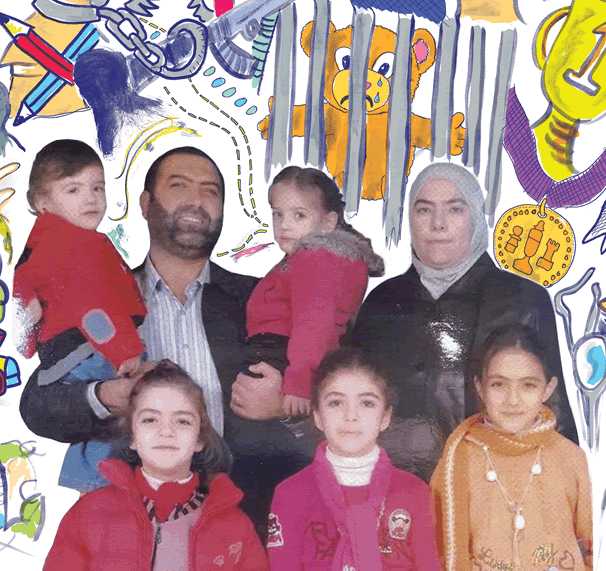
To My Valentine: Death Will Not Part Us

Ghassan al-Shihabi and his twin daughters © Private

Ghassan al-Shihabi and his twin daughters © Private

By Cilina Nasser, Amnesty International’s Syria researcher

When Siham Abou Sitte fell in love with Ghassan al-Shihabi, she was drawn by his determination to keep the memory of old Palestine alive, his passion for reading and writing and his commitment to his work.

They were both Palestinian refugees living in Syria’s Yarmouk neighbourhood in Damascus.

When he proposed, Ghassan promised to cherish Siham’s two children from a previous marriage, Carmen (then 12) and Yamen (then 15), and treat them as his own.

Six years after they got married, Siham says Ghassan never disappointed her.

Siham recalls the day her mother passed away, Carmen was upset by her grandmother’s death and ran to Ghassan who held her in his arms even though her own father was sitting there.

SEE THE REST OF THIS POST

UN Alarmed Over Syrian Humanitarian Funding Shortfall

Humanitarian Aid for Syria.

Humanitarian Aid for Syria. Click to explore interactive map.

Ahead of a crucial donors conference for Syria tomorrow, UN officials are warning of a funding shortfall that severely might affect the response to the spiraling humanitarian crisis. John Ging, the Director of Operations for the UN Office for the Coordination of Humanitarian Affairs (OCHA), cited “a funding shortfall that is affecting the ability of the UN and its partners to deliver vital assistance, including food, water and medical supplies”, according to the UN News Centre.

Already last week, Emergency Relief Coordinator Valerie Amos, urged more funding ahead of the donors conference:

We also need more resources. The humanitarian community has requested US$1.5 billion to help displaced people and the communities hosting them in Syria – and in neighbouring countries – for the next six months.

There is a funding conference on the 30th of this month, in Kuwait, which will be hosted by the Secretary-General of the UN and the Emir of Kuwait. We hope that the conference will yield the resources we need. If we do not receive these funds, we will not be able to reach the poorest and most vulnerable families who so desperately need our help.

SEE THE REST OF THIS POST