Time for a Full Court Press on Human Rights in Myanmar (Burma)

US President Barack Obama sits near Myanmar President Thein Sein as they participate in the US-Association of Southeast Asian Nations (ASEAN) meeting in 2011. Photo credit: SAUL LOEB/AFP/Getty Images

On the eve of President Obama’s historic visit to Myanmar (Burma), the first ever by a U.S. President, his host, President Thein Sein, has released 450 prisoners, a move surely calculated to curry favor with the United States. A smaller amnesty announced in September, just before the UN General Assembly convened, included about 60 political prisoners.

It remains to be seen whether any of an estimated 300 remaining political prisoners will be scattered among the latest batch of parolees. Nonetheless, the prisoner release is, by any measurement, an encouraging step. It says something important about the power and influence of the United States, and the desire of the new government of Myanmar to kiss up to President Obama and bask in the economic possibilities of a post-sanctions environment.

SEE THE REST OF THIS POST

President Obama: Recapture the Human Rights High Ground

President Obama

US President Barack Obama gives a thumbs-up after winning the 2012 US presidential election in Chicago on November 7, 2012. Photo: SAUL LOEB/AFP/Getty Images

When President Obama was first elected in 2008, many human rights activists rejoiced. It had been eight long years where the United States tortured, detained hundreds without charge and trial and tried to justify the horrors of Abu Ghraib.  His first campaign for the White House offered the promise of an administration that would recapture the United States’ credibility on human rights issues, bringing detention practices in line with international law, repudiating secrecy and ensuring that human rights weren’t traded away in the name of national security.

More simply, President Obama promised a new dawn of American leadership, one in which human rights would be given more than lip-service.

Unfortunately, the first Obama administration broke many of its promises when human rights were pitted against national security interests. When it comes to countering terrorism, President Obama has hidden behind national security imperatives to shield administration policy in secrecy and pursue programs such as expanded drone use and thwarted accountability.

SEE THE REST OF THIS POST

Will The Election Decide What Is Considered ‘Torture’?

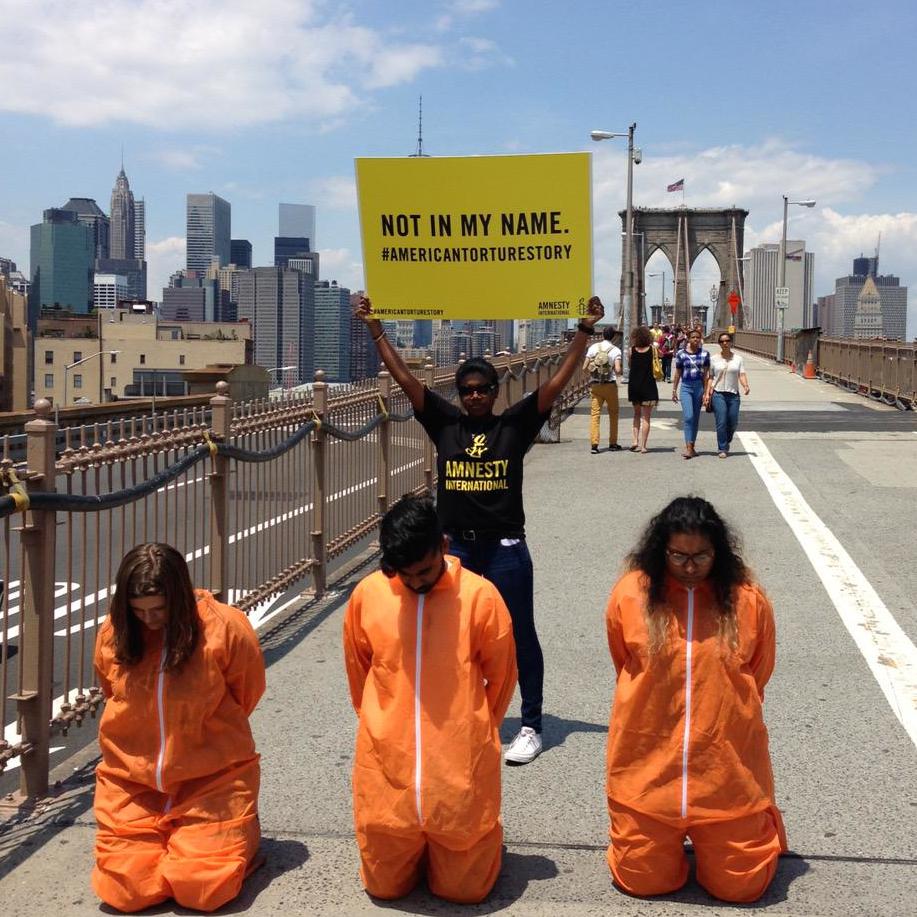
torture protest washington dc

© Shawn Duffy

Yesterday The New York Times published a story with the headline “Election May Decide When Interrogation Amounts to Torture.” It compares and contrasts President Obama and Governor Romney on torture.

While there are a number of points in the article one could address—for example, the claim that techniques approved in the Army Field Manual are “nonabusive”—the bigger picture is this:

  • U.S. torture was, and continues to be, about systemic institutional failures, including an over emphasis on domestic political values at the expense of international standards, and the failure to end impunity and lack of remedy for past abuses.

SEE THE REST OF THIS POST

Bush-Era Memo Raises New Questions About Torture and Accountability

©PAUL J. RICHARDS/AFP/Getty Images

Last weekend the State Department released a draft copy of a highly critical internal memo about the CIA’s use of ‘enhanced interrogation techniques’ that had long since been believed lost to posterity.

The draft, written by State Department Counselor Philip Zelikow in 2006, was uncovered by a Freedom of Information Act request submitted by the former Washington Independent reporter Spencer Ackerman. The final memo had been considered so explosive that the Bush administration instructed every single copy be collected and destroyed.

The memo was prepared in response to the passage of new legislation through Congress – the McCain amendment to the Detainee Treatment Act – that prohibited cruel, inhuman and degrading (CID) treatment or punishment. There was no way for the Bush administration to avoid the need to reevaluate the CIA black site program against a CID standard.

SEE THE REST OF THIS POST

Europeans Shame US on Secret Prisons

Zbigniew Siemiatkowski, former Head of Polish Intelligence

Last week was a good week for accountability — in Europe. The government of Poland and the European Parliament both took major steps towards holding European officials responsible for supporting the CIA’s illegal rendition to torture program.

In Poland the former Head of Polish Intelligence, Zbigniew Siemiatkowski, revealed that he had been charged with “unlawfully depriving prisoners of the their liberty” because of the alleged role he played in helping to establish a CIA secret prison in Stare Klejkuty, north-eastern Poland, in 2002-2003. SEE THE REST OF THIS POST

A Diminished Force for Good

president obama sri lanka speech

Photo: Tim Sloan/AFP/Getty Images

On Tuesday the United States sponsored a resolution at United Nations Human Rights Council calling on Sri Lanka to investigate alleged human rights abuses that occurred in the final days of the country’s struggle with the Liberation Tigers of Tamil Eelam (LTTE).

A United Nations Panel of Experts has estimated that as many as 40,000 civilians may have been killed in the final stages of the conflict as the Sri Lankan Army overran the last few pockets of LTTE opposition.

As Amnesty’s recent report Locked Away: Sri Lanka’s security detainees makes clear, there are good reasons to believe that human rights abuses still continue to this day. Instances of arbitrary and illegal detention have been widely reported, as have acts of torture and extrajudicial execution.

SEE THE REST OF THIS POST

Friends, Neighbors and the Fight Against Torture

Many Amnesty International members have long experience with the challenge of opposing state-sponsored torture in other countries.  But when human rights activists in North Carolina found that a trail of torture led to their own backdoor, they learned that talking to neighbors about human rights abuses is just as difficult as challenging a foreign government.

The Washington Post last week featured a story, “Hangar 3′s Mystery” about the work of North Carolina Stop Torture Now to document the activities of a small, nominally private air charter company, Aero Contractors,  whose headquarters are at an airfield in Smithfield, North Carolina.

SEE THE REST OF THIS POST

Haiti: A Safe Haven for "Baby Doc" Duvalier…Really?

Former Haitian dictator Jean-Claude Duvalier

Jean-Claude Duvalier lunches in Port-au-Prince (Photo Hector Retamal/AFP/Getty Images)

When I was in Haiti with Amnesty in December, training local activists in using new technology for human rights, I had the opportunity to meet many local defenders and activists.

We spoke openly about the prevalence of sexual and gender-based violence in Haiti and the impunity the perpetrators of those crimes enjoy.  We also spoke about the right to housing and the illegal forced evictions the Haitian government was conducting in displacement camps.

The one topic we didn’t discuss out rightly (for good reasons) was that Jean-Claude “Baby Doc” Duvalier had recently returned to Haiti, that he still has a network of supporters, and that he has not been held accountable for his alleged crimes — including torture, disappearances, and killings — committed during his 15 year reign.  Crimes for which it not appears he will not be held to account for.

SEE THE REST OF THIS POST

10 Years On, 10 Reasons Guantanamo Must Be Closed

guantanamo protest france

(Pierre-Yves Brunaud)

Ten years ago today the first twenty prisoners arrived at the US military detention facility in Guantanamo Bay. As we mark this dismal anniversary, it is instructive to take a moment to reflect on the damage Guantanamo continues to do to the global cause of human rights.

Guantanamo is much more than simply the sum of its parts, and outlined below are 10 powerful anti-human rights messages that the continued existence of the detention facility sends out to the world:

SEE THE REST OF THIS POST

Guantanamo: Reopening Under New Management

(JTF Guantanamo photo by U.S. Air Force Senior Airman Gino Reyes)

Next Wednesday will mark the tenth anniversary of the arrival of the first detainee at the military prison hurriedly erected on the arid scrubland of the United States Naval Station at Guantanamo Bay, Cuba.

In the past decade more than 775 individuals have made that journey, the vast majority have been released without charge after years of harsh captivity, 171 still remain – many cleared for release by the military but trapped by the restrictions placed on their resettlement by Congress.

The last prisoner arrived in Guantanamo in March 2008 but this spring we can expect the first new arrivals in four years to start trickling into the facility. The passage of the 2012 National Defense Authorization Act (NDAA) means that Gitmo has now been reopened for business.

SEE THE REST OF THIS POST