Speed Kills

Although Florida makes more death row mistakes than any other state, Governor Rick Scott is signing more death warrants and he's considering a bill that would shorten appeals (Photo Credit: Joe Raedle/Getty Images).

Florida Governor Rick Scott (Photo Credit: Joe Raedle/Getty Images).

Is Governor Rick Scott of Florida trying to speed up his state’s death penalty? He’s signing more death warrants (three executions are currently scheduled over the next month), and he’s considering a bill passed by the legislature that would shorten appeals.

He of course can, and should, veto this bill – known euphemistically as the “Timely Justice Act” – and we should all urge him to do so.

Florida has the nation’s most error-prone death penalty, having seen more death row inmates exonerated (24) than any other state. And it’s possible that a 25th is on the way. With 75 executions since its death penalty was reinstated, Florida has set free one person from death row for every three that have been executed.

The national rate, still appallingly high, is about one for ten. Which, not coincidentally, is the name of an important film project whose organizers have been crisscrossing the country interviewing death row exonerees.

Their most recent interview was with Florida exoneree Juan Melendez, who spent nearly 18 years on the Sunshine State’s death row. In the petition linked to above Juan writes that:

SEE THE REST OF THIS POST

Turning Away From Celebrating Death

Despite the recent filibuster in Nebraska, support for death penalty abolition is once again on the rise (Photo Credit: Allen Hailey).

Despite the recent filibuster in Nebraska, support for death penalty abolition is once again on the rise (Photo Credit: Allen Hailey).

LB 543, Nebraska’s death penalty repeal bill, was successfully filibustered this week by a minority of the state’s senators. During the course of two days of debate and occasional voting, it became clear that the votes to pass the bill might have been there, but the two-thirds majority needed to break a filibuster was not.

Nebraska’s death penalty, like capital punishment elsewhere, suffers from arbitrariness, unfairness, and general uselessness, facts that are dawning on a lot of legislators in a lot of states. The defense of the death penalty in the Nebraska debate was not passionate, and relied on the citing of discredited deterrence studies and a vague sense the executions somehow equal justice.

Nebraska’s embarrassing attempts to acquire lethal injection drugs may have been partially responsible for the sheepishness with which the pro-death penalty arguments seemed to be infused. But more likely it’s just that the days of cheering for executions and celebrating the death penalty are over.

SEE THE REST OF THIS POST

A Mother Speaks: “I Don’t Want To Lose My Son to the Death Penalty”

Vera Thomas

Vera Thomas

By Vera Thomas, Reggie Clemons’ Mother

When my son was young, he would say, “When I grow up I want to invent things.” Reggie as a young boy was always a people person. Almost 30 years later, he sits on death row, and I’m waiting to see whether or not the state of Missouri will take my son’s life. This is a parent’s worst nightmare.

My son’s name is Reginald Clemons, but we call him Reggie. He has been on Missouri’s death row for 21 years. No mother can truly imagine that there may come a day where she may have to watch her son take his last breath, listen to his last words and watch him executed. Last year, Reggie was granted an opportunity where his case would be reviewed by a judge who would then recommend to the Missouri Supreme Court whether or not my son should live or die. As we await the judge’s recommendations – expected to be announced by June 1st – I want you to understand a few things about my son, his case and just how flawed the death penalty system is.

Then I hope you will take action to stop Reggie’s execution and join the movement to abolish the death penalty in the state of Missouri and beyond.

SEE THE REST OF THIS POST

It’s Official! Death Penalty Now Abolished In Maryland

Amnesty International activists with Governor Martin O'Malley as he signed the death penalty repeal bill, making Maryland the 18th U.S. state to abolish capital punishment (Photo Credit: Amnesty International USA).

Amnesty International activists with Governor Martin O’Malley as he signed the death penalty repeal bill, making Maryland the 18th U.S. state to abolish capital punishment (Photo Credit: Amnesty International USA).

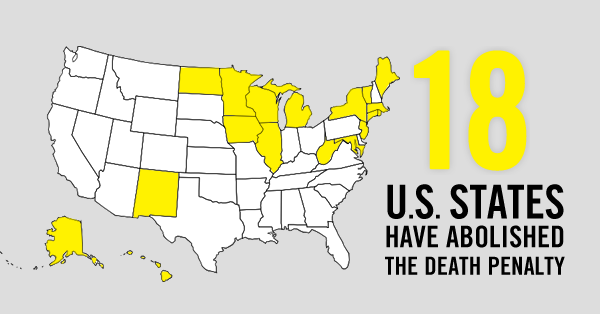
Maryland’s death penalty repeal bill has now been signed into law. Governor Martin O’Malley today made it official, but there is still work to do. There are still 32 states with capital punishment laws on the books, and there is the federal and military death penalty.

But while the U.S. will not be joining the ranks of abolitionist countries any time soon, the trend is certainly in the right direction, and more individual states will be repealing the death penalty in the near future, perhaps maybe even later this year.

The death penalty has gone from a third-rail political issue to one that is openly debated and hotly contested. As DNA technology has exposed the shortcomings of our judicial system, the public has become increasingly uncomfortable with the irreversible punishment of execution. Five Governors have now signed repeal bills since December 2007, and others, from states like Arkansas, Oregon, New Hampshire and Virginia, have publicly expressed a willingness to do so.

SEE THE REST OF THIS POST

Rushing To Judgment

Kharey Wise was wrongfully convicted of beating and raping a female jogger in Central Park in 1989 and spent 15 years in prison. He was released when the real assailant confessed to the crime (Photo Credit: Debbie Egan-Chin/NY Daily News Archive via Getty Images).

Kharey Wise was wrongfully convicted of beating and raping a female jogger in Central Park in 1989 and spent 15 years in prison. He was released when the real assailant confessed to the crime (Photo Credit: Debbie Egan-Chin/NY Daily News Archive via Getty Images).

For many who remember the terrible crime, the huge outcry and the media circus around the 1989 “Central Park Jogger” case, which was BIG national news, it may have come as a surprise to learn that all 5 of the teenagers convicted were in fact innocent.

But it probably shouldn’t have.

The film The Central Park Five, recently premiered on PBS, offers an important cautionary tale about how a rush to judgment, fueled by all-in media coverage of a particularly heinous crime, increases the chances that criminal justice officials will make critical mistakes, or engage in deliberate misconduct. The Reggie Clemons case, tainted by allegations of police abuse during the investigation and prosecutorial misconduct during the trial, is a reminder that a process compromised in this way can result in a death sentence.

At the other end of the spectrum, a rush to judgment can occur when there is a callous indifference on the part of authorities toward a crime they may perceive as less important because it was committed in a marginalized community. That’s what seems to have happened in the Carlos De Luna case, where an almost certainly innocent man was put to death for a crime another man named Carlos probably committed.

SEE THE REST OF THIS POST

‘Anyone Who Says We Live Comfortably on Death Row Has Obviously Never Been There’

Damon Thibodeaux

Damon Thibodeaux was released after 15 years on death row.

Damon Thibodeaux lived under the threat of execution for more than a decade.

Now 38, Damon was convicted of the murder of 14-year-old Chrystal Champagne, his step-cousin, and sentenced to death in 1997. But he always insisted on his innocence and after spending 15 years in prison, he finally walked out of Louisiana State Penitentiary at Angola – one of the harshest prisons in the country – a free man. This is his story.

SEE THE REST OF THIS POST

Three Human Rights Victories You Helped Make Happen

One Billion Rising in Washington, DC

Amnesty activists rise up with One Billion Rising in Washington, DC. ©Sarah K. Eddy

Today, we celebrate! Yes, you read that right.

While we often write about urgent news and actions about alarming abuses, today, we want to share some positive news – three major victories activists like you helped make happen.

You demanded justice for all women – not some.

You stood up to shameful efforts by some members of Congress to deny protection against domestic violence for Indigenous women, the LGBT community and immigrant women. Thanks in part to Amnesty activists, an inclusive Violence Against Women Act was reauthorized and signed into law on March 7. Find out more.

You helped end the death penalty in Maryland.

SEE THE REST OF THIS POST

Five ‘Crimes’ That Can Get You Killed

death penalty singapore

In some countries having consensual sexual relations outside marriage, offending religion and even drinking alcohol is punishable by death © Michael Matuzak

Even though most of the world has turned its back on the death penalty, some countries continue to impose capital punishment for acts like having consensual sexual relations outside marriage, opposing the government, offending religion and even drinking alcohol.

This is despite international law barring states from handing out death sentences for any of these crimes.

Here’s a list of some “crimes” that, in some parts of the world, can get you killed.

Iran's Sakineh Mohammadi-Ashtiani was sentenced to death by stoning for adultery (Photo Credit: Etienne Laurent/AFP/Getty Images).

Iran’s Sakineh Mohammadi-Ashtiani was sentenced to death by stoning for adultery (Photo Credit: Etienne Laurent/AFP/Getty Images).

1.        Consensual Sexual Relations Outside Marriage
In Sudan, two women, Intisar Sharif Abdallah and Layla Ibrahim Issa Jumul, were sentenced to death by stoning on charges of “adultery while married” in separate cases in May and July 2012. In both cases, the women were sentenced after unfair trials involving forced “confessions.” The sentences were subsequently overturned on appeal, and both women were released.

In Iran at least 10 individuals, mainly women, remain on death row having been sentenced to stoning for the crime of “adultery while married.”

SEE THE REST OF THIS POST

Who’s Next To Abolish The Death Penalty – Delaware?

The state of Delaware is known as the “Small Wonder”, but it has a surprisingly large death row.  With 17 men (10 of them African American) facing execution, Delaware’s death row is more than twice as big as Virginia’s, and more than 3 times the size of Maryland’s.  And Delaware has the third highest per capita execution rate of any state in the U.S. (behind Oklahoma and Texas).

But now, a bill making its way through the state legislature may mean than no one else will be sent to Delaware’s death row.  A death penalty repeal bill has already cleared the Delaware Senate, and will be taken up by the House on April 24.

There are deep concerns about costs, about wrongful convictions, and about the racial disproportionality of Delaware’s death penalty (the subject of a Cornell University study). These concerns, amplified by powerful appeals from family members of murder victims, and by the voices of those forced to become complicit in state killing (like this juror from a recent Delaware capital case), may be enough to bring about a second successful state death penalty repeal this year.

SEE THE REST OF THIS POST

Save Abdullah From the Ultimate Human Rights Violation

Abdullah al-Qahtani

Abdullah al-Qahtani

By Samir Goswami, Director of Amnesty International USA’s Individuals & Communities at Risk Campaign

Last week, we issued an Urgent Action to the disturbing news that Saudi Arabian national Abdullah al-Qahtani was at imminent risk of execution.

Abdullah was convicted of robbery and murder under Iraq’s Anti-Terrorism Law. While in custody, he was viciously beaten, burned and asphyxiated into “confessing” to being a member of al-Qaida. Four of Abdullah’s six co-defendants were executed last week and for a time, it seemed as though Abdullah was next.

But then, an amazing thing happened. We emailed a petition out to our Amnesty members and within 24 hours, received over 30,000 signatures.

Abdullah is still alive and pressure from activists like you likely helped spare his life. Today, Abdullah’s petition has over 40,000 signatures. But make no mistake – his execution is imminent. Abdullah’s attorney urges continued vigilance:

SEE THE REST OF THIS POST