HAPPENING NOW: White House Vigil to Mark 100 Days of Hunger Strike

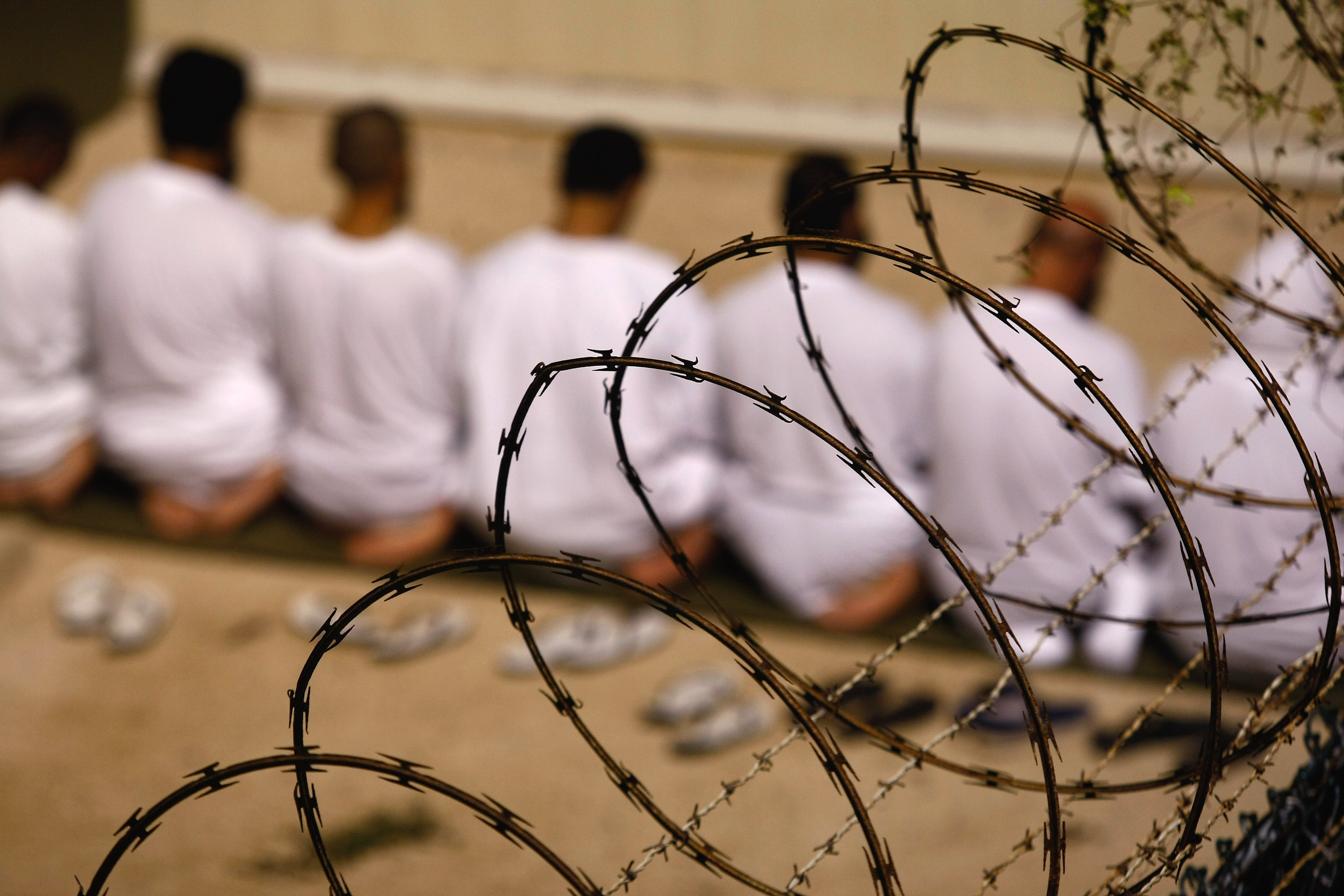
To mark the 100th day of the Guantanamo hunger strike, Amnesty International USA is holding a vigil outside the White House today with several other groups (Photo Credit: Mladen Antonov/AFP/Getty Images).

To mark the 100th day of the Guantanamo hunger strike, Amnesty International USA is holding a vigil outside the White House today with several other groups (Photo Credit: Mladen Antonov/AFP/Getty Images).

By Carrie Neff Maley, Human Rights Campaigner, Amnesty International USA

Today marks the 100th consecutive day that detainees at Guantanamo have been refusing food as part of a hunger strike that began in Camp 6 at the facility. According to a letter addressed to Secretary of Defense Chuck Hagel and signed by 50 attorneys representing detainees, the hunger strike which began on February 6, 2013, was initiated in response to,

“[W]idespread searches of detainees’ Qur’ans—perceived as religious desecration — as well as searches and confiscation of other personal items, including family letters and photographs, and legal mail, seemingly without provocation or cause.”

Both the hunger strike and the brutal practice of force feeding have become a symbol of the deprivation of human rights taking place at Guantanamo. Virtually every personal freedom has been stripped from the detainees, most of whom have not been charged with any crime and are not facing trial.

Guantanamo Bay has been the site of indefinite detention and numerous other violations of human rights since 2002. It is also, as Rolling Stone’s John Knefel calls it, “the site of a unique legal experiment that has no direct precedent in U.S. history.”

SEE THE REST OF THIS POST

Eyes on El Salvador: will officials act to #SaveBeatriz?

There has been an overwhelming amount of global support over the past few weeks for Beatriz and those in El Salvador working tirelessly on her behalf to save her life. Much of this support has emerged online via Twitter, Facebook, blogs and other outlets. Because of these digital tools, countless people are closely following events unfold in El Salvador and calling on the authorities to uphold their international human rights obligations by immediately granting Beatriz authorization for an abortion.

Will Salvadoran authorities listen to Beatriz’s plea and take action to save her life in accordance with her wishes and at the advice of the medical professionals caring for her?

SEE THE REST OF THIS POST

Eritrea’s Independence: 20 Years of Brutal Repression

Explore the interactive map of suspected places of detention in EritreaExplore the interactive map of suspected places of detention in Eritrea (Photo Credit: Amnesty International USA).

Explore the interactive map of suspected places of detention in Eritrea.

As the 20 year anniversary of Eritrea’s independence from Ethiopia approaches, the euphoria and – one may speculate – hope, that characterized celebrations on May 24, 1993 could hardly be more incongruent with the bleak reality faced by the Eritrean people today.

The scope of repression in Eritrea is truly striking. Thousands of prisoners of conscience and political prisoners have disappeared into a vast and secret system of detention, many never to be heard from again. This system of abuse is used to silent all dissent and punish anyone who refuses to comply, including suspected critics of the government, journalists, pastors and other members of “unregistered” religious groups, those who have been caught attempting to flee the country and those forcibly returned to Eritrea from other countries.

SEE THE REST OF THIS POST
Journalists Targeted in On-Going Conflict in Syria

In the vicious battles for power, both the Syrian authorities and armed opposition groups have deliberately targeted journalists who are risking their lives to report on the conflict and expose abuses (Photo Credit: Louai Beshara/AFP/Getty Images).

In the vicious battles for power, both the Syrian authorities and armed opposition groups have deliberately targeted journalists who are risking their lives to report on the conflict and expose abuses (Photo Credit: Louai Beshara/AFP/Getty Images).

Scores of journalists reporting on human rights abuses in Syria have been killed, arbitrarily arrested, detained, subjected to enforced disappearances and tortured over the last two years, Amnesty International said in a report released today, World Press Freedom Day.

These abuses have been carried out by the Syrian authorities and armed opposition groups, turning Syria into a highly dangerous country for journalists to work in.

The Amnesty International report, entitled Shooting the Messenger: Journalists Targeted by All Sides in Syria, details dozens of cases of journalists and media workers attacked or held since the 2011 uprising began, in an attempt to prevent them from reporting on the situation in Syria, including human rights abuses.

It also details the crucial role played by citizen journalists, many of whom risk their lives to make sure information about what’s going on inside the country is released to the outside world. Like their professional colleagues, this group has faced reprisals to prevent them carrying out their work.

SEE THE REST OF THIS POST
North Korea Sentences U.S. Citizen to 15 Years Hard Labor

Passersby watch a television broadcast in Seoul showing a picture of Kenneth Bae, a Korean-American tour operator detained in North Korea, and sentenced to 15 years' hard labor for "hostile acts" (Photo Credit: Kim Jae-Hwan/AFP/Getty Images).

Passersby watch a television broadcast in Seoul showing a picture of Kenneth Bae, a Korean-American tour operator detained in North Korea, and sentenced to 15 years’ hard labor for “hostile acts” (Photo Credit: Kim Jae-Hwan/AFP/Getty Images).

North Korea’s Supreme Court in Pyongyang has reportedly sentenced a U.S. national of Korean origin to 15 years of hard labor in the country’s infamous prison camps today after finding him guilty of various unspecified crimes against the nation.

Pae Jun-Ho (also known as Kenneth Bae), 44, was arrested in November 2012 in the north-eastern port city of Rason, a special economic zone near North Korea’s border with China. He had been operating as a tour guide for a group of five European nationals, who were immediately deported. Since his arrest, he had been held in solitary confinement and had limited consular support.

“The North Korean justice system makes a mockery of international fair trial standards – this case appears to be no exception,” said Rajiv Narayan, Amnesty International’s North Korea Researcher.

SEE THE REST OF THIS POST

The Egyptian Women Standing Up for Human Rights

Faced with a spike in sexual violence against female protesters, Egyptian women are overcoming stigma and recounting painful testimonies to force silent authorities and a reticent society to confront 'sexual terrorism' (Photo Credit: Mahmud Khaled/AFP/Getty Images).

Faced with a spike in sexual violence against female protesters, Egyptian women are overcoming stigma and recounting painful testimonies to force silent authorities and a reticent society to confront ‘sexual terrorism’ (Photo Credit: Mahmud Khaled/AFP/Getty Images).

The hopes and aspirations of Egypt’s 2011 uprising may rest in the ability of women to fight back against official discrimination and gender-based violence in the public arena.

Today, women play a leading role in the struggle for human rights in Egypt, but they’re paying a price for it through laws that marginalize them, increasing number of sexual assaults of women protesters and official pronouncements from authorities that women are to blame for the attacks on them.

A new Amnesty International campaign intends to reverse the loss of rights and to reclaim the promises of the Tahrir uprising by demanding that Egyptian authorities, both civilian and military, condemn sexual violence, fulfill their obligations to ensure women have the full spectrum of human rights and to press for accountability for past abuses.

SEE THE REST OF THIS POST

Save Abdullah From the Ultimate Human Rights Violation

Abdullah al-Qahtani

Abdullah al-Qahtani

By Samir Goswami, Director of Amnesty International USA’s Individuals & Communities at Risk Campaign

Last week, we issued an Urgent Action to the disturbing news that Saudi Arabian national Abdullah al-Qahtani was at imminent risk of execution.

Abdullah was convicted of robbery and murder under Iraq’s Anti-Terrorism Law. While in custody, he was viciously beaten, burned and asphyxiated into “confessing” to being a member of al-Qaida. Four of Abdullah’s six co-defendants were executed last week and for a time, it seemed as though Abdullah was next.

But then, an amazing thing happened. We emailed a petition out to our Amnesty members and within 24 hours, received over 30,000 signatures.

Abdullah is still alive and pressure from activists like you likely helped spare his life. Today, Abdullah’s petition has over 40,000 signatures. But make no mistake – his execution is imminent. Abdullah’s attorney urges continued vigilance:

SEE THE REST OF THIS POST

Why The New Investigation Into North Korean Human Rights Violations Matters

This posting is part of the North Korea Revealed blogging series, published in the context of efforts to establish a Commission of Inquiry at the current session of the UN Human Rights Council (February 25 – March 22). Join the conversation through #NKRevealed.

With overwhelming support from member states, the UN Human Rights Council in Geneva today established a Commission of Inquiry to investigate the deplorable human rights conditions in North Korea. Today’s development should be considered a milestone for international justice. While an independent investigation will not yield the ultimate impact we want—the much-needed closure of the political prison camps—it represents a crucial first step in uncovering the widespread and systematic nature of the crimes, and could ultimately lead to holding the perpetrators accountable. As an immediate impact, the commission has the potential to pressure North Korean officials to end their outright denial of the existence of the camps. We heavily campaigned for this outcome over the last few months – by putting the vast network of political prison camps on the map, uncovering a new security zone next to the infamous Camp 14, and most importantly, by sharing the powerful stories of survivors of the forgotten prisons, with the world.

SEE THE REST OF THIS POST

Help Commemorate 4 Important Human Rights Anniversaries at the AGM!

More than 10,000 Catholics gathered to commemorate the 30th anniversary of the assassination of of Archbishop Oscar Arnulfo Romero, a prominent human rights defender who was murdered during the Salvadorean civil war (Photo Credit: Jose Cabezas/AFP/Getty Images).

More than 10,000 Catholics gathered to commemorate the 30th anniversary of the assassination of of Archbishop Oscar Arnulfo Romero, a prominent human rights defender who was murdered during the Salvadorean civil war (Photo Credit: Jose Cabezas/AFP/Getty Images).

On Friday, March 22, Salvadoran torture survivor Carlos Mauricio will address the opening ceremony at Amnesty International’s Annual General Meeting (AGM) to commemorate four important anniversaries for El Salvador and the international human rights movement.

  1. On March 15, 1993, the United Nations Truth Commission issued its report on human rights abuses committed during the civil war in El Salvador (1980-1991). Unlike many other truth commissions, this international body identified the names of those found responsible when it established that there was “overwhelming evidence.”
  2. The Salvadoran government protected these individuals from prosecution and further investigation by quickly passing a second amnesty law on March 20, 1993. The 1992 amnesty law already protected anyone not named by the Truth Commission. Amnesty International has repeatedly called for these laws to be overturned, a position supported by several rulings by the Inter-American Human Rights Court.
  3. These events occurred just before another important milestone for El Salvador, the anniversary of the assassination of Archbishop Romero, an outspoken human rights defender, on March 24, 1980. The Truth Commission Report identified death squad leader Roberto D’Aubuisson as the individual who ordered Romero’s death. The 1993 amnesty law protected D’Aubuisson for the rest of his life.
  4. In recognition of the importance of Archbishop Romero’s role standing up for justice in El Salvador and as an inspiration for human rights defenders throughout the world, the United Nations declared that International Day for the Right to the Truth Concerning Gross Human Rights Violations and for the Dignity of Victims would be held on anniversary of his death, starting on March 24, 2011.

SEE THE REST OF THIS POST

Inside Syria: Documenting The War On Civilians

Citizen video coming out of Syria continues to uncover abuses that would otherwise go unnoticed (Photo Credit: ZAC BAILLIE/AFP/Getty Images)

Citizen video coming out of Syria continues to uncover abuses that would otherwise go unnoticed (Photo Credit: ZAC BAILLIE/AFP/Getty Images)

As the Syrian crisis hits its two-year mark, the toll on civilians continues to grow exponentially. Peaceful protests that started in March 2011 were quickly met by government authorities responding with deadly force, leading to systematic and widespread human rights violations amounting to crimes against humanity. Followed by the escalation into a full-fledged armed conflict by mid-2012, today, both government and armed opposition forces continue pursuing a military solution to the conflict. Caught in the middle are civilians, paying a horrendous price for this deadly stalemate.

Based on field research conducted over the last weeks, an Amnesty researcher inside Syria uncovered new evidence of the government’s assault on civilians, and its outright disregard for the laws of war. This is most dramatically symbolized by the government’s recent ballistic missile strikes against eastern Aleppo, flattening entire blocks and killing 160 residents; or by the increased use of internationally banned cluster bombs.

SEE THE REST OF THIS POST