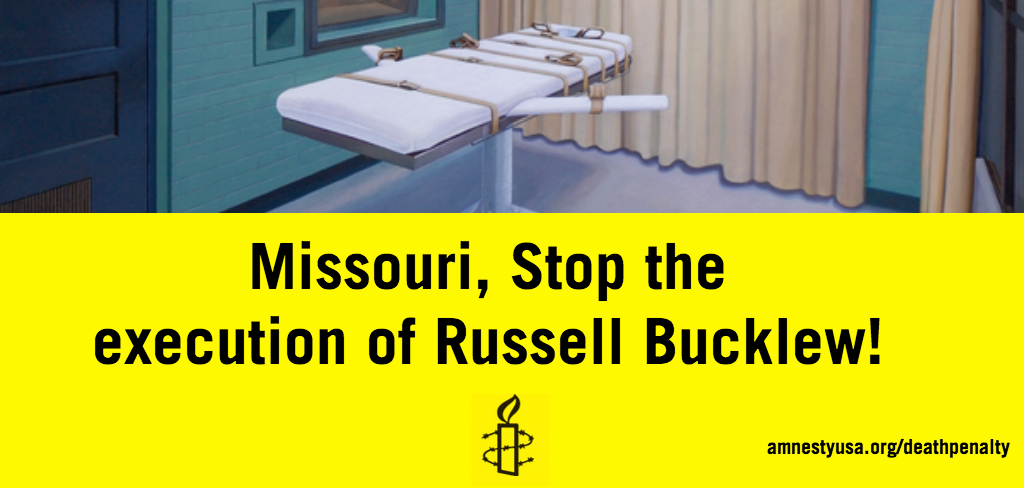
On May 21st, Missouri is scheduled to carry out the first execution since the horrific botched execution of Clayton Lockett.
What’s worse: there’s a high probability that Russell Bucklew’s execution will be just as horrifying as Clayton Lockett’s.

On May 21st, Missouri is scheduled to carry out the first execution since the horrific botched execution of Clayton Lockett.
What’s worse: there’s a high probability that Russell Bucklew’s execution will be just as horrifying as Clayton Lockett’s.

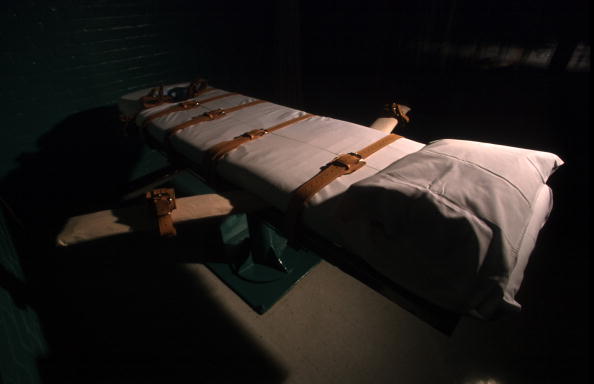
The state of Oklahoma attempted a “double execution” with a new “drug cocktail.” The procedure went horribly wrong and Clayton Lockett ultimately died of a massive heart attack (Photo Credit: Mike Simons/Getty Images).
By Robert Nave, State/Regional Death Penalty Abolition Coordinator
From time to time, we are reminded about the horror that the United States continues to endorse with the archaic practice of the death penalty.
Last night we were reminded of that yet again, as Oklahoma attempted a “double execution” with a new “drug cocktail.” The procedure went horribly wrong and Clayton Lockett ultimately died of a massive heart attack after the procedure was stopped mid-stream.

Reggie Clemons (Photo Credit: Private).
By Meredith Reese, Amnesty International USA’s Missouri State Death Penalty Abolition Coordinator
In the early morning hours of February 4th, Reggie Clemons’ parents found themselves once again preparing for a long ride across the state of Missouri to yet another court hearing. This one was to be held in Jefferson City in front of the Missouri State Supreme Court and has been a long time coming.
Reggie’s parents were joined by a large enthusiastic group of supporters who gathered 130 miles away in Saint Louis, in the gray, pre-dawn light to board a bus for the long ride to Jefferson City. Many of them taking off work, skipping school and losing countless hours of precious sleep between them, just to be there for this crucial moment.
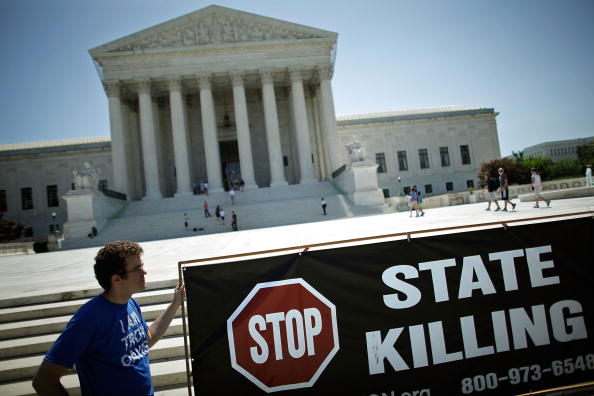
An activist fasts with other death penalty opponents in front of the U.S. Supreme Court in Washington, D.C. (Photo Credit: Chip Somodevilla/Getty Images).
By Abraham J. Bonowitz, State Death Penalty Abolition Coordinator for Delaware & Ohio for Amnesty International USA
Amnesty International opposes the death penalty as a violation of the right to life. Further, AI considers death row itself to be cruel and unusual, setting aside that an execution method which does not deliver death within seconds might be better termed “death by torture.”
What else can you call it when witnesses describe a prisoner coughing, snorting, and heaving against his restraints for upwards of 20 minutes before finally dying? This is exactly what happened last week when Ohio executed Dennis McGuire.

Missouri law provides members of an execution team with anonymity, and the pharmacy for Joseph Paul Franklin’s execution has been added to the team. Without knowing which pharmacy is providing the execution drugs, the drugs’ efficacy cannot be guaranteed (Photo Credit: Joe Raedle/Newsmakers).
Legend has it that more than a century ago, a Missouri Congressman stated at a banquet that he was not impressed by fancy speeches or “frothy eloquence,” concluding “I am from Missouri. You have got to show me.” Since then, Missouri has been known as the “Show Me” State.
One thing the people of Missouri are not being shown is how their state is killing prisoners.

Billy Slagle died in a holding cell, like the one in the Southern Ohio Correctional Facility featured here, three days before the state of Ohio was to execute him (Photo Credit: Mike Simons/Getty Images).
Back in 2010, the cruelty – and absurdity – of the death penalty was on full display when Brandon Rhode tried to commit suicide just days before he was to be executed by the state of Georgia. The state rushed him to the hospital and saved his life – only to execute him a week later.
The suicide attempt reportedly left Rhode brain damaged. He was shackled to a restraint chair for the next 7 days, and then the execution proceeded. The lethal injection may have been botched, as Rhode’s eyes remained open the entire time.
This weekend, Billy Slagle was found hanged in his cell on Ohio’s death row. Slagle died three days before the state of Ohio was to execute him. The Ohio Department of Rehabilitation and Correction has promised a “complete investigation.”
Despite several diagnoses of paranoid schizophrenia and even though the Supreme Court has declared executing the severely mentally ill unconstitutional, John Ferguson is scheduled to be executed in Florida on August 5th (Photo Credit: Joe Raedle/Newsmakers).
John Ferguson, a 65-year-old man with a long history of mental illness, including several diagnoses of paranoid schizophrenia by prison doctors, and who refers to himself as the “Prince of God,” is set to be executed in Florida on August 5th. His crimes were horrific, no question. Ferguson was convicted of a total of eight murders committed near Miami, earning him a total of eight death sentences.
But executing the severely mentally ill, or “the insane,” has been unconstitutional since 1986 when the U.S. Supreme Court ruled so in Ford v. Wainwright (a Florida case, as it turns out). In its decision, the Court, led by Thurgood Marshall, reasoned that it is cruel and pointless to put prisoners to death who don’t understand why (or in some cases even that) they are being killed.

Warren Hill
A challenge to Georgia’s “Lethal Injection Secrecy Act“ has led the Fulton County Superior Court in Atlanta to extend Warren Hill’s stay of execution. An appeal from the state of Georgia won’t be filed in time and his execution warrant will expire.
The secrecy law, which went into effect July 1, allows the state to withhold from the courts information about the drugs they intend to use in executions. This, of course, makes it impossible for the courts to determine if said drugs will be effective enough to prevent excessive pain and suffering that would render the execution a “cruel and unusual punishment” in violation of the constitution.
There is also a “separation of powers” question: can the executive and legislative branches of government set up a system that keeps the judicial branch in the dark about the most awesome and extreme power the state can wield? In other words, is it OK that the public and the courts are denied information they need to ensure that the law is upheld and that human rights and constitutional rights are protected?
Warren Hill – an African American man with an IQ of 70 who was convicted of murder in 1991 – was set to be executed at 7 p.m. tonight. He has been found intellectually disabled by all the doctors and experts who have examined him. The carrying out of his execution would directly contradict the 2002 U.S. Supreme Court decision in Atkins v. Virginia, in which the Court found the execution of the “mentally retarded” to be ‘cruel and unusual punishment.’ Several jurors as well as the victims’ family have expressed their opposition to the use of the death penalty in this case and have asked that his sentence to be commuted to life without parole.
Hill was granted a stay today, not on those grounds, but on the grounds that the secrecy surrounding Georgia’s lethal injection drugs violates Hill’s constitutional rights. Georgia’s new “Lethal Injection Secrecy Act” shields from the courts and the tax-paying public how Georgia has managed to obtain its lethal injection drugs. This prevents Hill from know whether or not the drugs to be used will be effective or whether they will cause serious pain and suffering in violation of the Constitution.
Late afternoon on July 3 when the least possible number of people would be paying attention, using a new law that makes the acquisition of execution drugs a state secret, Georgia scheduled the execution of Warren Hill, who is now set – barring intervention from the US Supreme Court or the Georgia Attorney General – to be put to death on July 15.
Georgia authorities did this despite the fact that: