Human Rights Now Human Rights Now
The Amnesty International USA Web LogVisit us
  Subscribe

Posts Tagged ‘drones’

Modern Warfare 2

Friday, December 4th, 2009

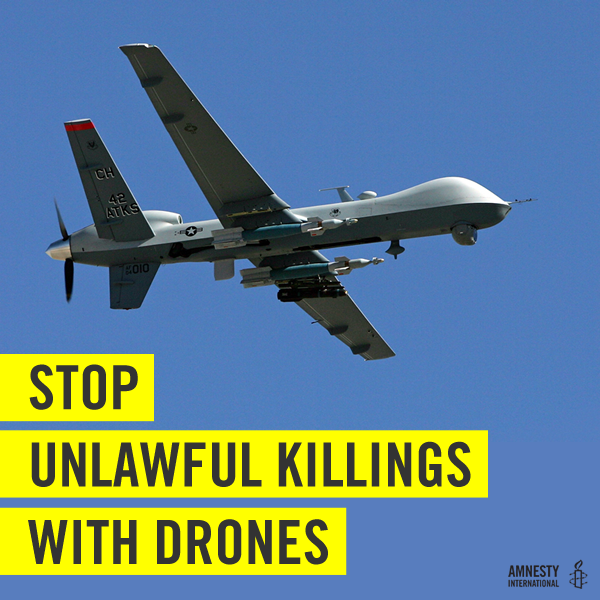
The New York Times reported this morning that in the past two years the US military has killed more than 400 militants in 80 drone strikes for the loss of only 20 civilian casualties.

Pentagon sources credit the increased sophistication of modern weapons systems and intelligence collection platforms for this record of success. This is a bold claim and one that Amnesty International has been trying to investigate on the ground in a very hostile operational environment.

At present, reliable facts are hard to come by. However, we can say with the confidence derived from hard-earned experience that these numbers are unlikely to stand up to scrutiny. A similar conflict in which airborne platforms have been used by a sophisticated modern military to target insurgent and other armed groups is the second Intifada which engulfed the Gaza Strip in September 2000.

Between September 2000 and September 2002 Israel’s intelligence-led policy of targeted killing claimed the lives of approximately eighty Palestinian militants and fifty innocent bystanders.

In one well-documented incident in July 2002 the Israelis dropped a laser-guided bomb on a house occupied by Hamas official Salah Shahada. Shahada was killed along with thirteen others, ten of whom were children.

(more…)

The Guardian ‘Gaza War Crimes Investigation’ – 3 videos

Tuesday, March 24th, 2009
Hermes 450 unmanned drone used by Israel.

Hermes 450 unmanned drone used by Israel.

The Guardian website posted three incredible videos March 23rd by Clancy Chassay, Christian Bennett, Sarah Brodbin, Maggie O’Kane and Mustafa Khalili.  The Guardian team conducted their own investigations into some of the charges that Israel committed war crimes during the Gaza offensive.

The first video covers the use of precision weapons, many fired by unmanned drones, to attack civilians.  Amnesty International mentioned these drones in their report ‘Fuelling conflict: Foreign arms supplies to Israel/Gaza’.  The fact that these unmanned drones are used to attack as well as surveillance is a fact usually censored by the IDF on Israeli reporters and foreign reporters based in the region.

The second video deals with allegations by both sides of human shielding.  Amnesty issued a report on how both Israel and armed Palestinian groups, including Hamas, were using military tactics that endangered civilians.  Chassay also mentions the deadly campaign that Hamas undertook during the crisis to injure and kill ‘collaborators’ and political opponents which Amnesty also investigated.

The third video shows footage of attacks on medical personnel while trying to tend to wounded and attacks on hospitals and medical facilities.  Amnesty also covered this issue in the blog, LiveWire and in a report.  [Donatella Rovera, senior researcher for AI on Israel and the Occupied Palestinian Territories, posted blog entries while on the fact finding mission to southern Israel and the Gaza Strip.]

Faulty Intelligence, Wanton Recklessness, or a Combination of the Two

Monday, February 2nd, 2009

(As originally posted to Livewire)

1 February 2009: A 13-year-old girl who was asleep in her bed; three primary school-age boys who were carrying sugar canes; two young women on their way to a shelter in search of safety; a 13-year-old boy on his bicycle; eight secondary school students who were waiting for the school bus to take them home; an entire family sitting outside their home – these are among the many victims of missiles fired from Israeli UAVs (unmanned aerial vehicles), commonly known as drones.

Here in Gaza people call the drones “zannana”, an onomatopoeic description reflecting the buzzing sound that they emit as they fly overhead. Their main function is surveillance, but, in recent years, Israeli forces have also used them to fire missiles, often to assassinate “wanted” Palestinians.

An Israeli journalist told us that the military censor does not permit Israeli media to publish any reference to strikes by drones. These missiles seem to be very precise, with a relatively small but concentrated radius. Yet, they have killed or injured hundreds of civilians, including many children, though the reason for this – whether due to faulty intelligence, wanton recklessness, or a combination of the two – is unclear.

In many of the cases we investigated, we found a consistent pattern: each missile is packed with tiny metal cubes that increase its lethal effect. These are blasted with extreme force, penetrating through metal doors and steel pylons and embedding deep into concrete walls.

Today, we visited the place where a missile fired from a drone killed two women and three children from the same family on the morning of 15 January. It was in a Bedouin village on the outskirts of Beit Lahiya, in north Gaza. Those killed were three children, their mother and their grandmother.

The family’s home had been destroyed some 10 days earlier by the blast from a powerful air strike that apparently targeted a nearby tunnel. After this, the family had gone to stay with relatives across the road. The two women and three children were killed by the missile when they returned to the remains of their home to retrieve some of their possessions.

Earlier, we investigated several other cases in the Khan Yunis area, in the south of the Gaza Strip. There, the latest drone attack had occurred on 29 January, despite the 11-day-old ceasefire, in the centre of Khan Yunis.

The target, it seems, were two suspected Palestinian militants who were riding a motorcycle. They were hit and injured, but so too were 16 civilians, almost all of them children, as might have been predicted considering the location and time of the missile strike.

It was launched at a point opposite the hospital, only a few metres distant from the entrance to a UN primary school and directly in front of a row of food stalls. The attack was launched at 11.30am, just as children were leaving school at the end of the morning lessons.

On 2 January, three boys from the al-Astal family – eight-year-old Abderrabbo, his brother Mohammed, aged 11, and Abd-al-Sattar al-Astal, also just 11 – were killed by a missile fired from a drone while collecting sugar cane in al-Qarara, north-east of Khan Yunis. At the scene, we again found metal posts peppered with the signature square holes from the shrapnel blasted from the drone missile.

Another characteristic of these missiles is a small hole that penetrates deep into the ground, leaving few remains. We asked to borrow a shovel from local farmers in order to dig down and try to recover any remains from the missile. At this, some village youths stepped up enthusiastically and began to dig into the sandy ground.

Some six feet down, they recovered small parts of the circuit board and other shards of the missile. We urged the children’s family to hold on to these and keep them safe, as possible evidence to be considered in any future investigation.

Originally posted to Livewire by Donatella Rovera, Middle East & North Africa Researcher at the International Secretariat of Amnesty International in London

 
Search this blog