Sarah Hager is a volunteer leader at Amnesty International USA, serving as Chair of the Southern Africa Co-Group where she guides the efforts of Country Specialists monitoring human rights in twelve countries. Sarah provided crisis intervention and trauma therapy counseling services to rape survivors for seven years after college before returning to graduate school. Her Master's level coursework focused on the intersection of law and psychology and in law school, Sarah concentrated on international law and public policy.
She has traveled to Russia and Thailand to complete legal research on national and international terrorism policies and the impact of HIV/AIDS policies on women. Sarah also worked in South Africa at the Legal Aid Board where she assisted with criminal defense and appellate cases as well as civil litigation challenging violations of constitutional rights. She has published a paper examining the international soft law regarding internally displaced persons and the ability of international actors to regulate behavior of States that displaces persons within a sovereign border, utilizing Zimbabwe as a case example. Sarah also volunteered as a statement taker for the Liberian Truth and Reconciliation Diaspora project.
Sarah has a Master's degree in Clinical Forensic Psychology from Drexel University and a law degree from Northwestern University. She currently practices law in Washington DC.
Zimbabwe gets a lot of bad press, but not many are aware of some of the amazing people making a difference there every day. These are people, who usually at great personal risk, fight for human rights, civil liberties, justice, equality and a better Zimbabwe for all. So here’s a shout out to some personal heroes of mine and I hope you are equally inspired. (Feel free to share stories about other amazing human rights heroes in Zim or southern Africa in general in the comment section.)
Betty Makoni Betty is a teacher who got tired of hearing about the relentless sexual abuse of young girls and decided to do something about it. She started the Girl Child Network in Zimbabwe to provide a safe place, healing and support for young girls surviving sexual assault. Many of the girls were victimized because of a belief that sex with a virgin cures AIDS. As a result of her efforts, Betty has been targeted by security forces in Zimbabwe and forced to flee the country for her safety. A documentary film tells the story of Betty and the girls she helps. Betty has also been nominated as CNN’s Hero of the Year. You can vote for Betty on CNN’s web site until November 19th. Vote early and often! (more…)
Even though The Mo Ibrahim Foundation decided no former African leader merited its $5 million prize this year; when it ranked African nations on good governance, five of the top 10 were countries monitored by Amnesty International USA’s Southern Africa Co-group: Botswana, South Africa, Namibia, Sao Tome y Principe and Lesotho. Zimbabwe was in the bottom five. (I know: shocking.)
Botswana, which you might only be familiar with through The No. 1 Ladies’ Detective Agency, is often hailed as a shining light of democracy in Africa. Last week, Batswanans went to the polls and elected Ian Khama to a new 5 year term as president. Khama assumed the presidency last year when then President Festus Mogae stepped aside for his then-Vice President in order to allow him to run as an incumbent this year. Talk about your smooth transitions of power, right? Except this is the second time this has happened and also ensures that the same ruling party remain in power for the past 43 years.
Update: Amnesty International warns of deteriorating human rights conditions in Zimbabwe.
Amnesty International warned today that Zimbabwe is on the brink of sliding back into the post-election violence that erupted last year, risking the stability brought about by the creation of the unity government in February. The organization called on the Southern African Development Community (SADC) foreign ministers, visiting Zimbabwe on Thursday to assess the eight month-old unity government, not to ignore the worsening human rights situation. Amnesty International also challenged SADC and the African Union (AU) to tackle human rights violations by government bodies under the control of ZANU-PF.
The civil rights boycotts that occurred in the southern US during the 1950’s are some of the most famous and successful examples of this pressure tactic. In the last two weeks, boycotts have suddenly became en vogue again. Tsvangirai, Zimbabwe’s embattled Prime Minister, declared his political party, MDC-T, would boycott the compromise government formed following contested elections last year. This seemingly courageous attempt to force compliance with the negotiated agreement by his opponent, President Mugabe, was promptly undercut in its significance and boldness when accused war criminal Karadzic declared he was boycotting his trial at the Tribunal for the Former Yugoslavia in the Hague. Awkward…
Mozambique goes to the polls tomorrow in its fourth general election since independence from Portugal in 1975. Parliamentary control and the Presidency are up for grabs. Election observors from the African Union, the Commonwealth and the Southern African Development Community have arrived to monitor the elections. Which is good, because so far things have been a bit bumpy.
President Armando Guebuza of the governing Frelimo party is being challenged by Afonso Dhlakama, leader of Renamo, and Daviz Simango, mayor of Beira city and founder of the Mozambican Democratic Movement. Seventeen parties and two coalitions are meanwhile in the running for seats in the Mozambican parliament and, for the first time, provincial assemblies.
So far, there have been several incidents of violence between supporters of Frelimo and Renamo, resulting in harm to persons and property. Several people have been hospitalized or forced to seek medical attention while offices have been vandalized and property stolen. Violence is often a serious issue in Mozambique; Amnesty International has documented many incidents of extra-judicial killings by the police with few prosecutions of the perpetrators and no justice for the victims or their families.
Mozambique has recently been praised by the International Monetary Fund for its economic policies and last month President Guebuza chaired the World Climate Conference, taking a strong stand on the need for new environmental policies to address climate change. Emerging in 1992 from a devastating civil war, Mozambique is now poised to take strong strides in the region and become a leader on climate change, tourism and economic development (despite the nation’s current continuing desperate poverty). Let’s hope a free and fair election unmarred by further violence or human rights violations speeds Mozambique further along this path.
So it basically goes like this: Angola starts to kick out Congolese citizens living in Angola, almost 18,000 since July. The Democratic Republic of the Congo (DRC) says “for reals?” and shows a bunch of Angolan citizens to the door, well, border when it launches its own repatriation operation. So then Angola says “oh, yeah?” and increases the pace of expulsions of Congolese. The DRC says, “yeah,” and sends more Angolans over the border, approximately 28,000 since August. Angola says…well, you get the point.
Angola and the DRC have a long history of porous borders with refugees crossing back and forth escaping internal conflict, citizens looking for employment and best of all, politicians dabbling in each others internal conflicts. But the violence and disregard for the lives of those involved in this latest tit for tat is seriously uncool.
Angolan police, immigration officers, citizens and soldiers have been accused of beatings, sexual assaults and stealing the possessions of the Congolese they are expelling. (more…)
Over the past thirty years, tens of thousands of Zimbabweans have died, faced torture, or been assaulted at the hands of the State. Yet the legal system has refused to hold the perpetrators of these human rights violations accountable. That is, perhaps, until now.
Justina Mukoko, Director of the Zimbabwe Peace Project, spent ten years documenting such incidents of state-sanctioned violence. On December 13, 2008, she was kidnapped by persons then unknown from her home. She spent almost three weeks in incommunicado detention, enduring long rounds of interrogation punctuated by beatings on the soles of her feet. The purpose of her torture: force an admission she had recruited fellow Zimbabweans for military training in Botswana in order to overthrow Zimbabwe’s government.
The lie that justified her detention might have stood if not for Mukoko and her lawyers. As she went to trial, her attorneys filed a motion before the Supreme Court contending that her arrest, torture, and detention denied her basic rights under Zimbabwe’s Constitution. Further, habeas corpus petitions forced State Security Minister Didymus Mutasa to admit in court that she had been illegally abducted by state agents acting under his direct orders.
On September 28th, the Supreme Court handed down a shocking decision. The justices unanimously ordered the government to drop all charges against Mukoko, ruling that the state’s unlawful abduction, use of torture, and prolonged covert detention was so lawless and reckless that justice demanded that the state drop all charges against her.
For Justina Mukoko, this ruling was not enough, as the individuals who mistreated her remained unpunished. Less than a week later, she filed a $500 million civil suit against her tormentors: Mutasa, Police Commissioner Augustine Chihuri, and several police officers and members of the Central Intelligence Organisation. Her lawyers may soon add her actual torturers to the list.
It will take years for the politicized judiciary in Zimbabwe to become an independent and objective enforcer of the rule of law. Justina Mukoko, after coming back from the black hole of a Zimbabwe prison, had a tenacity and courage that forced even the justices on Zimbabwe’s highest court to try to reign in President Robert Mugabe’s torturers. If her case is a sign of growing judicial independence, and if individual security agents will be held accountable for their brutality, Zimbabwe may yet start to move toward justice for those human rights defenders who have suffered, like Mukoko, so terribly much for so unmercifully long.
By Rowly Brucken, AIUSA Zimbabwe Country Specialist
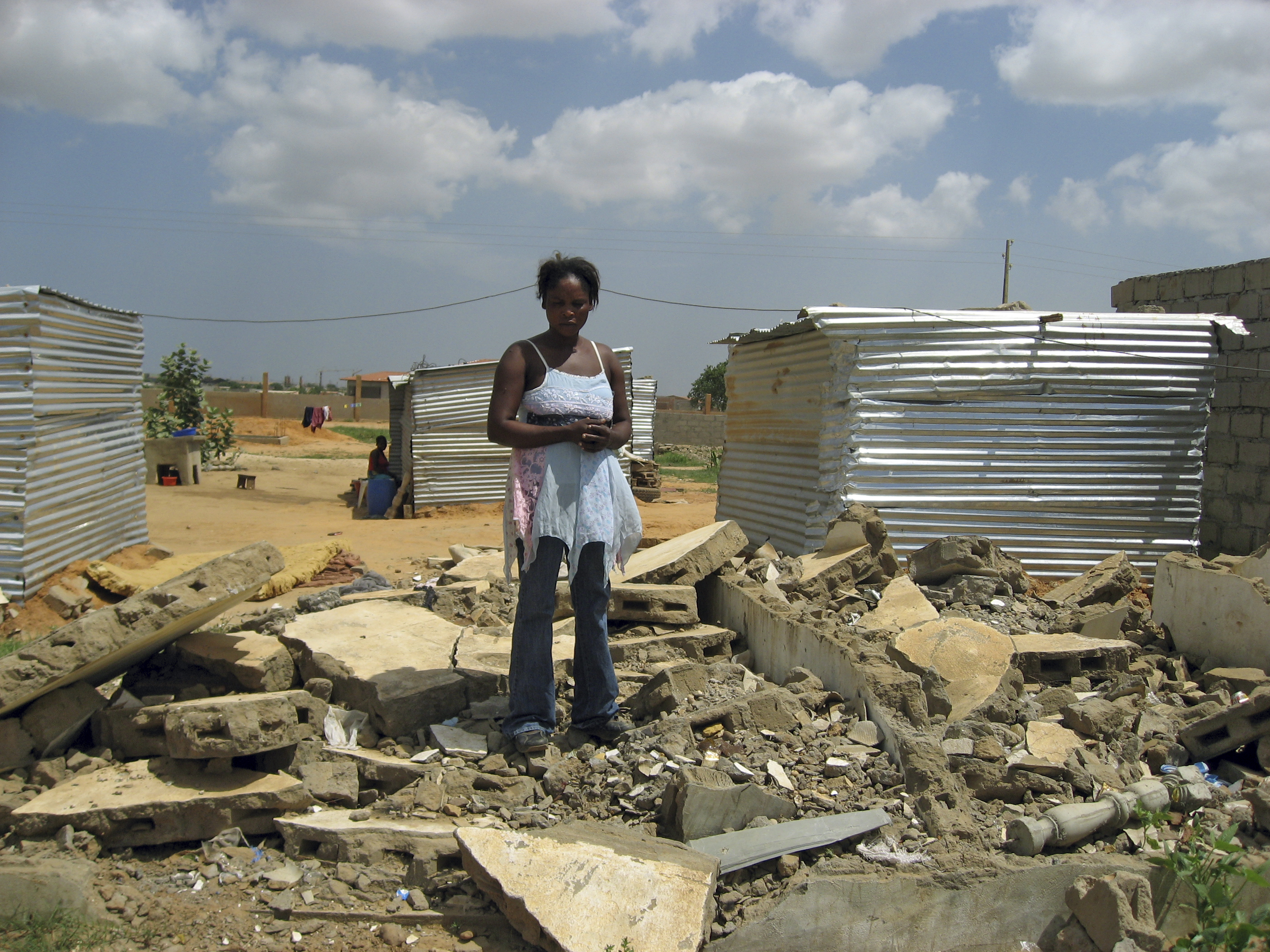
A woman sits in the ruins of houses destroyed in the Cambamba neighbourhoods of Luanda, Angola to make room for a luxury housing complex.
Luanda, Angola hosted World Habitat Day last year. UN Habitat’s Executive Director Anna Tibaijuka called upon President dos Santos to allocate 10% of Angola’s oil income to upgrading vital social services such as housing, plumbing, clean water and electricity and praised Angola’s stated commitment toward a slum revitalization program. Approximately 85% of Angolans live in slum conditions surrounding major cities.
In response, President dos Santos stated his government was waging “a sustained war against chaotic urbanization.” I would agree with that analysis. It certainly looks like a battleground when armed forces enter a neighborhood, raze houses, evict families and destroy their homes and belongings. Since 2001, Amnesty International has documented the forcible eviction of more than 10,000 persons from slum dwellings in Angola, often accompanied by violence including police indiscriminately firing their weapons and beating women and children. And the reason why these evictions have occurred? To facilitate urban development projects and the construction of luxury housing.
In April 2009, Angola announced the creation of a special fund to build one million houses over the next four years. That’s great. But three months later in July, three thousand families were forcibly evicted from the Luanda neighborhoods of Iraque and Bagdad, utterly demolishing homes and possessions.
“Armed police, soldiers and presidential guards arrived in both neighbourhoods at 3am on 20 July and ordered people out of their homes before bulldozers began to demolish the houses. The residents stood and watched as their homes were being demolished. Some of those who tried to stop the demolitions were beaten.”
Well, that’s a little awkward Mr. dos Santos. You say you are following up on your campaign commitment to provide housing because you are concerned about social unrest and then you have your government thugs throw families into the street in the middle of the night in winter, beating them up when they try to salvage a portion of their possessions and dignity. Seems like you might want to consider building those houses at a faster pace than the ones you are tearing down.
Help Human Rights Live in Angola. Stand Up Against Forced Evictions in Africa. Take action now.
Seven hundred thousand people. That is the number of people forcibly evicted from their homes and business over a three month period in 2005. This is the equivalent of bulldozing the entire city of Charlotte, North Carolina. Seem incomprehensible? Seem reprehensible? Think something should be done about it? We think so to.
Between May and July 2005, the government of Zimbabwe orchestrated Operation Murambatsvina; a slum clearance program touted by officials as necessary to decrease rising urban populations by requiring people to return to rural areas. In reality, the purpose was to disperse members of political opposition parties and disrupt their ability to organize. Houses and informal businesses were bulldozed, leaving people with nowhere to live and no way to earn a living.
Currently, thousands of informal traders continue to face forcible eviction as the government targets vendor stalls in Harare for demolition. Unemployment in Zimbabwe remains near 90%. These market stalls provide goods at a price affordable by the populace and generate necessary income for those unable to work in the formal sector. The mayor of Harare defended these actions by claiming the stalls were a health hazard and violated city regulations.
As we continue a week commemorating World Habitat Day, Amnesty International calls upon the government of Zimbabwe to cease the harassment of informal traders, discontinue the egregious practice of forcible evictions which violate Zimbabwe’s obligations under the International Covenant of Economic, Social and Cultural Rights and provide restitution to those it has previously displaced. Join Amnesty International in its effort to assure that Human Rights Live Here.
Jestina Mukoko with cards from Amnesty International members.
Today the Zimbabwe Supreme Court ruled in favor of the motion brought by Jestina Mukoko’s lawyer that all charges against her should be dropped due to the torture she experienced at the hands of state security agents.
Late last year, Jestina Mukoko, head of the Zimbabwe Peace Project, was abducted from her home, illegally detained, tortured and charged with recruiting persons to participate in alleged militia camps in Botswana. She was one of 18 persons abducted and tortured around this time and charged with variations of the same crime. On June 25th of this year, the Supreme Court heard a petition from Ms. Mukoko and her co-defendants claiming their arrest was unconstitutional because they were illegally abducted and tortured. The Attorney General’s office admitted that Ms. Mukoko was illegally detained by state security agents but asserted that this should have no bearing on the case.
Amnesty International spoke with Jestina today after she left court, who said she was “over the moon with excitement.”
We also want to convey a message to YOU, Amnesty’s activists, in the eloquent words of Amnesty’s Zimbabwe researcher:
“Each time I meet Jestina she is quick to mention her appreciation of the campaign by AI members for her freedom. Thank you all for the actions you have been taking to apply pressure on the Zimbabwean authorities so that people like Jestina can enjoy their freedom. Jestina was the face of at least 23 human rights and political activists who were victims of enforced disappearances from October to December 2008. But we all kept the light burning for them and wishing them freedom. Human rights defenders like Jestina count on our support. Our cards, letters, calls and sometimes just good wishes gives them hope to fight for another day. “
President Robert Mugabe granted an interview to CNN reporter Christiane Amanpour today – his first interview with a Western news agency in years. Mugabe spoke to Amanpour while he was in New York attending the UN General Assembly meeting. The interview yielded many choice soundbites. Here are a few of my favorites:
He denied that Zimbabwe is in economic shambles, saying it grew enough food last year to feed all its people. Which is interesting because the World Food Program is busily feeding 1.8 million people in Zimbabwe and Malawi is busily selling maize to Zimbabwe because it needs to import food to feed its citizens.
In refuting criticisms leveled against his government’s policies by Bishop Desmond Tutu, Mugabe said “He doesn’t know what he’s talking about, the little man.” Hmmm. The Nobel Peace Prize committee might refute that assertion.
“Elections don’t go all that smoothly all the time in many countries,” he said. “Look what happens elsewhere. They didn’t go smoothly here, look at what happened during the first term of Bush.” Ok. Valid that elections don’t always go smoothly. However, if you are going to point specifically at the Bush/Gore contest as your comparative example, you might want to think again; because even though many of us were pretty darn unhappy with how things went down, there are some very stark differences between Zimbabwe in 2008 and the US in 2000.
First, not going “smoothly” is probably a pretty good description of events in the US whereas it masterfully understates events in Zimbabwe. In the time between the actual vote and the final determination of who won, people were not killed, tortured and sexually assaulted in the US in an attempt to create an atmosphere of political intimidation.
Second, our political stand off was resolved by the US Supreme Court and ended with a peaceful transfer of power (whether we wanted it or not). In Zimbabwe, Mugabe had his arm twisted into a power sharing agreement and then signed that agreement with his fingers crossed behind his back.
Now I’m not ever going to say that things are all sweetness and light and wonderful in the US, but I do think Mugabe could have come up with a slightly better comparison if he wanted to make a point that elections don’t always go “smoothly.”
You can watch the interview here and respond in our comments section with your favorite moments.
Amnesty International works to protect human rights worldwide. We have more than 2.2 million supporters, activists and volunteers in over 150 countries, and are completely independent from government, corporate or national interests.
Learn more about us at AmnestyUSA.org »
Geneve Mantri is the Government Relations Director, for Terrorism and Counterterrorism and Human Rights at Amnesty International USA. He is responsible for advocacy for Amnesty International on national security issues including detainees, torture and accountability. See all »