One of the side effects of our new social networking technology is we are getting to see human rights violations and the workings of security agencies occur in real time through tools such as Facebook, YouTube and Twitter. I’ve known that for some time, but the knowledge feels different when it’s someone you have met who is affected.
Laila el-Haddad is a Duke graduate and Gaza activist. She lives most of the time in Gaza but has returned to Duke on several occasions to talk about the Middle East. She was passing through Cairo’s airport today on way to another venue when suddenly she and her family members were detained.
el-Haddad immediately started Twittering her detention. If you have a Twitter account, you can follow her postings at @gazamom. For more than 12 hours she described the unreal procession of questionings, of waiting, of discussions with the other detainees. The most recent word she gives is authorities are denying her return to Gaza but will deport her to the U.S.
But not just a window into the detention, Twitter was also a means by which other activists could come to her assistance. Friends at Duke immediately got in touch; American and Egyptian authorities were pressed for more information. It seems unlikely that in this case she was saved from actual arrest, but Twitter has been credited in gaining releases in other cases.
Beyond the Twitter aspect, the detention also casts light on the hypocracy of many Arab governments’ support for Palestinian activists. The government’s support for Palestine often goes only as far as it serves their own purposes; when activists make the cause their own independently, it often — as it did in Laila’s case — brings the weight of the security forces on them.
More on Twitter: Activists in Moldova are attempting to see what a revolution would look like on Twitter. Click here for the story.
(Thursday update and More on Twitter: Today, Egyptian police broke into the house of blogger Wael Abbas. His reports are available on Twitter at @waelabbas.)
The top dogs of international justice and reconciliation today called on UN Secretary General Ban Ki-moon and UN member states to set up a UN commission of inquiry into the Gaza conflict, adding a powerful voice to extend the current insufficient investigation beyond attacks against UN facilities.
The impressive group of signatories surely knows what they are talking about: they are the world’s top investigators and judges, having worked on transitional justice issues in countries like Rwanda, the former Yugoslavia, Sierra Leona and South Africa – among others. Signatories include Richard Goldstone, Mary Robinson and Desmond Tutu.
In their letter they identify a key issue of why a proper investigation is so important, and how it will ultimately help to prevent future violence:
Without setting the record straightin a credible and impartial manner, it will be difficult for those communities that have borne the heavy cost of violence to move beyond the terrible aftermath of conflict and help build a better peace.
A prompt, independent and impartial investigation would provide a public record of gross violations of international humanitarian law committed and provide recommendations on how those responsible for crimes should be held to account. We have seen at first hand the importance of investigating the truth and delivering justice for the victims of conflict and believe it is a precondition to move forward and achieve peace in the Middle East.
Additionally, I want to add one point: in setting the record straight, it will be possible to assign individual responsibility for the crimes committed, as opposed to group responsibility, a further key requirement to prevent further conflict.
If anyone can explain to me why attacks against UN installations, like the UN compound in Gaza City, by Israeli forces are worth investigating, while attacks against civilians and civilian infrastructure in both Gaza and Southern Israel are ignored – please go ahead. And if you agree with me on the importance of this issue, support the call for full accountability.
PS: Thanks to Crisis Action for initiating this letter!
Tristan Anderson, a 37 year old American, was shot in the head by Israeli forces with a high velocity tear gas canister while participating in an on-going protest of the wall being built illegally by Israel in the West Bank town of Ni’ilin. Another Ni’ilin villager was also shot.
Four residents of Ni’ilin, including children, have been killed while protesting the confiscation of their land in the recent past.
[Note: In 2004, the International Court of Justice found all parts of the wall being built on Palestinian land illegal and that these portions should be removed. Instead the GOI continues to build the wall on occupied territory - including this portion in Ni'ilin.]
According to the IDF, the protestors were ‘endangering security forces’. According to eyewitnesses, the IDF were stationed on a hill overlooking the protest and the protest had already begun to disperse when a tear gas canister was fired directly at people. Tristan was not near any stone throwers or throwing stones himself.
A fellow protestor from Sweden said she could see Tristan’s brain when she went to provide aid and that medical personnel and the ambulance was detained outside the village by the IDF, but were finally allowed to pass and tend to Tristan. The video below shows the paramedics when they arrive on the scene, clearly marked, while the IDF continues to fire tear gas canisters directly at the medics, the wounded and those trying to help.
WARNING: Video provided has some gruesome footage towards the end.
This Monday, March 16 2009 marks the 6th anniversary of the death of another US citizen, Rachel Corrie, who was crushed by an American made Caterpillar bulldozer while trying to negotiate with the driver not to destroy the home of a Palestinian pharmacist in the Gaza Strip. She was 23 years old.
UPDATE (March 13): Orly Levi, a spokeswoman at the Tel Hashomer hospital in Tel Aviv, tells Ha’aretz:
He’s in critical condition, anesthetized and on a ventilator and undergoing imaging tests,” She described Anderson’s condition as life-threatening.
Israeli activist Jonathan Pollack told Ynet:
“… the firing incident took place inside the village and not next to the fence. There were clashes in the earlier hours, but he wasn’t part of them. He didn’t throw stones and wasn’t standing next to the stone throwers.”
“There was really no reason to fire at them. The Dutch girl standing next to him was not hurt. It only injured him, like a bullet.”
UPDATE (March 13 11:50pm): Tristan is sedated and in surgery, being seen by an ophthalmologist, and will likely be in surgery for some time.
UPDATE (March 14 7:42pm: Tristan’s girlfriend, Gabrielle Silverman, talks of trip to hospital and Tristan’s condition on Bay City News and KTVU.
Note: Friends of Anderson will hold a demonstration on Monday at 4 p.m. at the Israeli Consulate, located at 456 Montgomery St. in San Francisco.
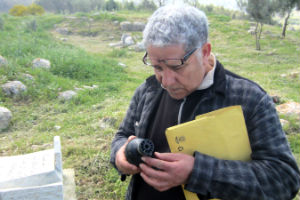
UPDATE (March 15): Photo of the new tear gas canister type (with propeller) that hit Tristan Anderson. Photo from www.palsolidarity.org website.
UPDATE (March 15): A public statement by the parents of Tristan and articles written by Tristan can be found at the San Francisco indymedia website.
BACKGROUND INFO:
More information on the two Palestinian minors/children killed in 2008 by IDF in Ni’ilin from www.btselem.org:
Yusef Ahmad Yunes ‘Amira
17 year-old resident of Ni’lin, Ramallah and al-Bira district, injured on 30.07.2008 near the Separation Barrier in the area of Ni’lin, Ramallah and al-Bira district, by gunfire, and died on 04.08.2008. Did not participate in hostilities when killed. Additional information: Died after being critically wounded during a confrontation with soldiers and Border Police.
10 year-old resident of Ni’lin, Ramallah and al-Bira district, killed on 29.07.2008 in Ni’lin, Ramallah and al-Bira district, by gunfire. Did not participate in hostilities when killed. Additional information: Killed when taking part in a procession against the Separation Barrier in Nil’in.
On September 23, 2008 a Jerusalem Post article ran about an incident where tear gas was used against a European Union official and delegation when he was visiting Ni’ilin.
UPDATE (March 23, 2009 2:30pm est): According to Ma’an News Agency, Israeli troops beat some activists and journalists who were gathered for a press conference by Tristan Anderson’s parents in an east Jerusalem neighborhood.
UPDATE (April 17, 2009 12:00pm est): A Palestinian man was killed by Israeli forces in Bi’lin, West Bank by the same tear gas canister type that had critically injured American Tristan Anderson only a month ago during a protest.
Lancet, a British public health journal, released yesterday a series of reports entitled Health in the Occupied Palestinian Territories which examine the health situation in the West Bank and Gaza. The five reports cover the status of health in the OPT, maternal and pediatric health, common diseases, health as a security issue, and a health-care system assessment for the occupied Palestinian territories and take into consideration issues such as security, the availability of resources, the various conflicts between Israel and Palestinian organizations, the blockade of Gaza, and the occupation of Israeli troops. The series was compiled as a joint effort by health scientists in the OPT, together with help from WHO, associated UN agencies, and academic institutions in the USA, UK, Norway, and France.
It makes claim that the security threats to the region originate, at least partially, in constraints imposed by Israel such as checkpoints and border closings which prevent access for patients and medics, create a shortage of medical supplies, and “affect every aspect of Palestinian life, such as the ability to travel, work, marry, study, worship, and be with family…[thereby] compromis[ing] the social determinants of health by increasing social exclusion, unemployment, and creating barriers to food, social support and transport.
The reports also discuss how the armed conflicts in the area have negative mental health impacts in children. Studies done even before the recent conflict illustrated the traumatic effects that witnessing brutally violent acts can have on children, resulting in “behavioral problems, fears, speech difficulties, anxiety, anger, sleeping difficulties, lack of concentration at school, and difficulties in completing homework. In order to solve the health crisis in the region, the series calls for a just political and economic solution, claiming that if international laws were respected and enforced, they could “protect Palestinians from insecurity
The full series can be found at www.thelancet.com(free registration is required).
Gisha, Legal Center for the Freedom of Movement, an Israeli non-profit organization, produced this powerful animated short, ‘Closed Zone’. They tapped the talent of Yoni Goodman, the animator of the award winning animated film ‘Waltz with Bashir’:
You can also watch the short video on the making of ‘Closed Zone’.
In the meantime, Secretary of State, Hillary Clinton is in the Middle East committing $900 million in aid to the Palestinians. The issue remains how the aid being purchased is to make it into the Gaza Strip to the people that need it. Secretary Clinton urged the Israeli government to allow more aid into the strip, but stopped short of asking for full, unhindered access. Israel, as a gesture, has agreed to let more aid in. Over 80% of the 1.5 million depend on aid from outside sources and the 100+/day trucks being allowed in are simply not enough to deal with the incredibly dire humanitarian situation.
Yesterday, the U.S. State Department leaked an upcoming pledge of $900 million to reconstruct Gaza and support the Palestinian Authority. No money will pass through Hamas but will be filtered through non-governmental organizations. I applaud this assistance but question the effectiveness of aid without negotiations and opening the borders. Daniel Levy, a senior fellow at the Century Foundation and an Israeli citizen, wonders whether money will pass into Gaza at all:
“The next step is opening the border crossings, and that requires more than just signing a check.”
The irony, of course, is that the US is supplying aid to victims of US made weapons. The U.S. has been trading arms with Israel while donating to Palestinian reconstruction. In fact, the Obama administration has continued Bush’s pledge of $30 billion in military assistance to Israel over the next 10 years. There are no investigations into whether US weapons were used in the recent conflict to harm civilians. And given that the US refuses to speak to the governing power in Gaza, who, then, can be held accountable? And how?
These structural obstacles to the $900 million pledge present a challenge for the Obama administration. Levy goes on to analyze this:
“There are structural flaws – not least, that Israelis and Palestinians cannot negotiate the core issues alone and need an outside broker and that Palestinian statehood cannot be incubated under Israeli occupation. The very structure of the peace process has become a disincentive for peace itself. There now exists an opportunity to do away with the illusion, even if the danger also exists that events may take a more violent, confrontational and bloody turn.
A different approach would require the US conducting back-to-back talks with the Israeli side and with a Palestinian (or Palestinian plus Arab states) interlocutor, in which one attempts to address the key legitimate needs and concerns of each party. It will be the role of the US and international partners to produce a proposal and implementation plan.”
That’s not to say that aid is not needed:
“Two separate Palestinian surveys have put the cost of the damage at just under $2bn.” – the BBC reports.
But maybe the problem’s too big for a check—no matter how large or generous-to fix. Nonetheless I am cautiously optimistic about this overture from the US and I hope the US follows up by pressing Israel to open up the borders so that aid can enter without hindrance.
In the first congressional visit since Hamas was elected in 2006, Representative Brian Baird from Washington, Rep. Keith Ellison from Minnesota and Senator John Kerry visited Gaza yesterday. They witnessed and reported the devastation of the population and the dire need of humanitarian assistance. Rep. Ellison, Middle East and South Asia Subcommittee member and the first Muslim congress member, stated that:
People, innocent children, women and non-combatants, are going without water, food and sanitation, while the things they so desperately need are sitting in trucks at the border, being denied permission to go in – Rep. Ellison.
Aid is slowed by the blockade as Palestinians rebuild.
None of the men toured the area as representatives of the Obama administration and all refused to meet with Hamas, but they opened up a dialogue between American lawmakers and Gaza residents. Rep. Baird “wanted to witness the situation on the ground” and helped Palestinian aid workers highlight the humanitarian crisis to the BBC. Sen. Kerry, on the other hand, emphasized the problems with Hamas leadership, while touring a bombed out American school:
…Your political leadership needs to understand that any nation that has rockets coming into it over many years, threatening its citizens, is going to respond – Sen. Kerry.
As lawmakers balance the politics of Hamas and Israeli interests, the Palestinian people are left with the shocking humanitarian devastation, 5,000 home destroyed, 1,300 lives lost, and over 5,000 injured. More pointedly, Rep. Braid describes:
The amount of physical destruction and the depth of human suffering here is staggering. Entire neighborhoods have been destroyed, schools completely leveled, fundamental needs such as water, sewer, and electricity facilities have been hit and immobilized. Relief agencies, themselves, have been heavily damaged. The personal stories of children being killed in their homes or schools; of entire families wiped out, and relief workers prevented from evacuating the wounded are heart wrenching. What went on here? And what is continuing to go on, is shocking and troubling beyond words. – Rep. Baird.
On February 12, 2009, UN Secretary-General Ban Ki-Moon announced that a UN Board of Inquiry had begun its work “to review and investigate a number of specific incidents that occurred in the Gaza Strip between 27 December 2008 and 19 January 2009 and in which death or injuries occurred at, and/or damage was done to, United Nations premises or in the course of United Nations operations.”
While the UN has legitimate reason to be concerned about attacks on UN sites–including the Israeli attack on a UN school, the UN should expand its investigation to examine a broader range of possible war crimes, not just those directed at UN facilities or staff.
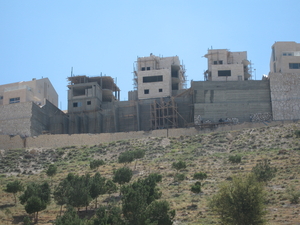
In other news, the fighting eslcalated again, with fresh Israel attacks on tunnels in Gaza that Israel says Palestinians use to smuggle weapons. Palestinians insist that the tunnels are the only way to permit food and supplies to enter, given the harsh blockades by Israel even on humanitarian assistance into Gaza. The BBC also reports that Israel “claimed” 425 acres of West Bank land, a possible indication of pro-settler policies by the new Israeli government.
…a leading Israeli newspaper says the Israeli civil administration in the West Bank has designated an area of 172 hectares (425 acres) as state land.
Haaretz says the decision could pave the way for some 2,500 new settlement homes to be built.
However, several steps of government approval are required for building work to begin, which the newspaper says means construction is still a long way off.
Israeli has pledged to freeze settlement activity on occupied land, but it has continued to expand existing settlements, built in defiance of international law since 1967.
Right-wing parties which fared well in Israeli elections on 10 February are strong supporters of the settlement movement, which is seen as a major obstacle to the two-state solution supported by the US.
As Israelis vote, Palestinians rebuild; Tents serve as temporary shelter while humanitarian supplies filter into Gaza.
The crisis in Gaza continues as the Israeli elections wrap up. Of the two front runners, Tzipi Livni of Kadima and Benjamin Netanyahu of Likud, Livni appears to have a small lead as of this evening. The question remains, who will address the humanitarian crisis in Gaza with the most diligence? Palestinian Fatah leaders worry about a Prime Minister Benjamin Netanyahu, or Bibi, on the Israeli right, who they say would bolster Hamas in response to his appointment. Then there’s Tzipi Livni, who has campaigned on a platform for peace, although she was an architect of the recent conflict. She leans towards negotiations for a Palestinian state, where Bibi would not. But the unknown of the election may be Avigdor Lieberman whose nationalist policies ban Arab journalists from his press conferences. Lieberman may be the controversial candidate but Livni and Netanyahu are the two to watch in the next few days. Israel’s elections are parliamentary offering 33 parties and proportional representation. Voters select their party of choice and cast one vote; however, the Prime Minister is nominated by the President, based on the parties elected.
“Palestinian commentators explained that after being disappointed by governments led by all three major Israeli parties – Labor, Kadima and Likud – the public has stopped hoping. Regardless of who heads it, every government has continued building in the settlements and failed to reach a final-status agreement, the pundits said.” – Haaretz.
While election results filter in today and tonight, U.N. Secretary General Ban Ki-moon continues to work with the UN Relief Works Agency in Palestine to investigate possible targeting of UN civilian facilities committed by Israeli forces. The elections and the UN investigation, however, have missed a vital human rights concern.
In a recent Media Briefing, Amnesty International reported the maiming, killings, abductions and disappearances of Hamas’ political opponents in Gaza. At least 20 people have been killed since the start of the Israeli offensive in December. Individuals targeted were former prisoners, Fatah affiliated politicians, and those who “collaborated with Israel.”
The testimonies and medical evidence of these attacks are irrefutable:
“Jamal al-Ghandour, in his mid-50s, was shot dead in his bed in al-Shifa hospital at about 4pm on 28 December by unmasked gunmen wearing plain clothes in front of relatives and other witnesses. Also present were uniformed members of Hamas security forces, who took no action to prevent the killing or to apprehend the perpetrators. Jamal al-Ghandour was receiving treatment for injuries he had sustained that morning in the Israeli bombardment of Gaza’s Central Prison, where he had been detained with his son since January 2008; both were accused of “collaborating” with the Israeli army.” – Amnesty International
Victims are hesitant to come forward under the Hamas de-facto administration. Amnesty International is gravely concerned that administration in the Gaza Strip – instead of taking steps to stop and prevent deliberate killings and other grave abuses being perpetrated by its forces and militias – is not only disregarding such abuses but is justifying and even facilitating and encouraging them.
“The government differentiates between abuses [of the law] and the actions taken by the resistance to protect itself from collaborators in times of war… There will be no mercy for the collaborators who have stabbed our people in the back.”
Unfortunately, al-Nanu provided a green light to target anyone based on any allegations of “collaboration” with the Israeli army, without giving those targeted a possibility to defend themselves against such accusations.
While Israel works out their new administration and the UN investigates attacks on UN facilities, there must be an impartial commission to investigate these human rights abuses and Hamas must be held accountable to fair trial standards and to witnesses and victims. One step towards an investigation into these abuses would be for the UN to heed Amnesty International’s call for their inquiry into the conflict to include evidence of violations by all sides, not solely against UN facilities.
Written by Ally Krupar. Edited by Zahir Janmohamed.
Amnesty International works to protect human rights worldwide. We have more than 2.2 million supporters, activists and volunteers in over 150 countries, and are completely independent from government, corporate or national interests.
Learn more about us at AmnestyUSA.org »
Brian Evans is the Campaigner for Amnesty International USA’s Death Penalty Abolition Campaign. Prior to moving to Washington, DC, in 2006, he was a founding member of the Texas Moratorium Network and a member of the Texas Coalition to Abolish the Death Penalty, organizations working to stop executions in the state of Texas. See all »