Israel/Gaza: International Monitors and Arms Embargo Needed NOW

A doctor checks vital signs of haneen Tafish by light of his mobile phone in Al Shifa hospital, Gaza City, November 15, 2012. Haneen Tafish eventually died from her injuries. (Photo: Anne Paq/Activestills.org)

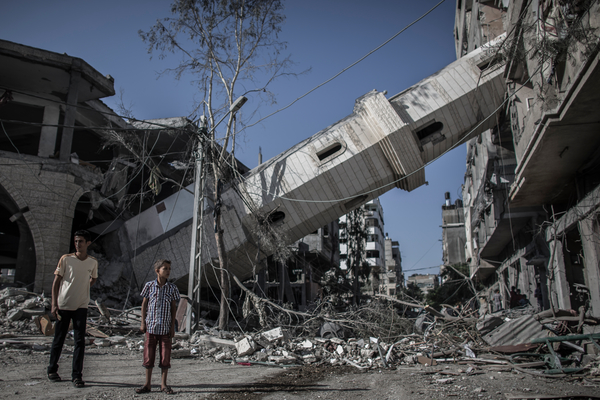
Amnesty International is calling for the  prompt deployment of international monitors and an arms embargo on both Israel and armed Palestinian groups, including Hamas de facto administration in Gaza, to offer more civilian protections immediately and monitor and document violations of international human rights and humanitarian law.

Since the assassination by Israel of Hamas leader Ahmad al-Ja’abari on November 14 in Gaza City, there has been an escalation of violence between Israel and armed Palestinian groups in Gaza that has left scores dead and injured.  The conflict shows no signs of abating and looks to be repeating the same mistakes made during operation ‘Cast Lead’ four years ago.

SEE THE REST OF THIS POST

‘You May Say That We are DREAMers…’

Maryland Dream Act

‘You may say that we are DREAMers…’ But, as the vote on Question 4 of the Maryland ballot demonstrated, we are definitely not the only ones! You helped successfully defend the Maryland DREAM Act last night as Marylanders voted 58% to 42% in favor of the act.

The Maryland DREAM Act is legislation that would afford students from Maryland, who have been state high school students, and whose parents file state taxes, the opportunity to pay in-state tuition rates for their higher education. (For more information regarding the Maryland DREAM Act, check out our Maryland DREAM Act one-pager and our infographic. 

This is an important victory for the students and families who will be affected, for DREAMers across the country and for human rights supporters fighting for immigrants’ rights and the right to education. It’s important for another reason too. Ballot referendums are a critical barometer of public opinion, and an indication of how ready U.S citizens and residents are ready for political change on the issue in question. The results in Maryland are pretty clear – voters strongly support common sense measures that recognize the contributions that our talented young people, regardless of immigration status, are making to the nation.

SEE THE REST OF THIS POST

Can Election Day Votes Bring Human Rights To The USA?

voting booth

In Maryland and California, it is extremely important that those of us who want to establish a real culture of human rights here in the U.S. get out and vote. © AFP/GettyImages

In 1941, FDR enunciated the Four Freedoms, signalling U.S. commitment to basic rights for all. In 1948, Eleanor Roosevelt led the creation of the Universal Declaration of Human Rights, the foundational document for human rights in the modern world. But despite these hopeful beginnings more than half a century ago, a culture of respect for human rights has not taken root here in the USA. The seeds were planted, but the soil has not been fertile.

From torture and executions to discrimination in things like education, or even marriage, the U.S., at the federal and state level, often engages in policies that are willfully contrary to human rights norms accepted (if not always practiced) in much of the rest of the world.

That’s why, in Maryland and California, it is extremely important that those of us who want to establish a real culture of human rights here in the U.S. get out and vote.

SEE THE REST OF THIS POST

A Big Chance for Immigrant Students in Maryland?

On November 6, 2012, Maryland residents will vote on a ballot initiative that will allow undocumented students who have lived in Maryland, whose parents have paid taxes in Maryland, and who meet some other conditions, to pay in-state tuition fees for their higher education.

The Maryland DREAM Act, if it is able to come into force, would enable many DREAMers to attend state universities that would otherwise be prohibitively expensive. At a time when many states in the U.S. were passing anti-immigrant legislation (adding to a climate of hostility to migrants, those perceived to be migrants, and Native Americans), Maryland passed legislation in April 2011 that realized the right to equal access to education for a significant number of students.

Now, the Maryland Dream Act is in jeopardy. Let’s defend the right to education, and the Maryland DREAM Act! On November 6th, Vote ‘Yes!’ on Question 4 on the ballot. Help spread the word by sharing this graphic widely:

SEE THE REST OF THIS POST

Secret US Drone Program Still Getting Away With Killing Children

drone victims pakistan

Pakistani tribesmen protest against US drone attacks in the Pakistani tribal region. © AFP/Getty Images

At tonight’s debate President Obama and Governor Romney will face questions for the last time before the Presidential Elections. Even as they speak and try to sell themselves to the American public, scores of unmanned aerial vehicles will be flying over the skies of northwestern Pakistan, their remote control operators sitting thousands of miles away, and the hundreds of thousands of villagers under their shadow cowering in fear for when they will spit out a missile and wreak destruction over the land that has been their home for centuries.

In the words of the recent report compiled by NYU and Stanford University:

“Drones hover twenty four hours a day over communities in northwest Pakistan striking homes, vehicles and public spaces their presence terrorizes men, women and children giving rise to anxiety and psychological trauma among civilian communities”

Even as the Presidential candidates sparred on October 11, 2012, President Obama had already authorized his 297th drone strike since taking office, it was the deadliest one in 2012, killing 17 people, the second strike in less than twenty four hours in the area. In the aftermath of the strike the Foreign Ministry of Pakistan said the strike was a “clear violation of international law and of Pakistani sovereignty”. As has been the case, for the hundreds of other strikes the objections made by Pakistan, a country against which the United States has not declared war, they were ignored.

SEE THE REST OF THIS POST

The Girl On The Schoolbus

Malala Yousafzai

Pakistanis protest against the assassination attempt on Malala Yousafzai in Islamabad on October 11, 2012.© AFP/GettyImages

Malala Yousufzai got on the bus on Tuesday morning to go to school. With her, were two of her school friends, also bound for Mingora, the largest town in Pakistan’s Swat District, where their school is located. It was an ill-fated journey. Before the girls could get to school that morning, Tehreek-e-Taliban gunmen accosted the bus.

One of the girls, Shazia Razaman confirmed that they were specifically looking for Malala. She was easy to find, and when they did find her, they shot her in the head. Hours, later as Pakistanis and the world, watched, aghast and stunned at yet another act of inhumane violence, the spokesperson for the Tehreek-e-Taliban, specifically took responsibility for the attack saying:

“She is a Western-minded girl. She always speaks against us. We will target anyone who speaks against the Taliban.”

SEE THE REST OF THIS POST

Ending the Use of Child Soldiers: One Step Forward

child soldiers DRC congo

Child soldiers in the Democratic Republic of Congo. © Amnesty International

In a victory for children in war-torn Democratic Republic of Congo, the DRC government recentlysigned a plan of action with the UN to eliminate the recruitment and use of child soldiers in their military forces, including a first-of-its-kind plan for protecting children from sexual violence.

This historic step comes after several years in which the Government of the DRC had part of its US military aid withheld under the landmark Child Soldier Prevention Act (CSPA). Moving forward, it is imperative that the world and the United States keep a close watch to ensure there is a robust implementation of the national action plan including, for example thorough screening processes to prevent child soldiers recruited into the M23 rebel forces from joining the DRC military. It is arguable that given the links between M23 and the government of Rwanda restrictions on US aid should also considered for Kigali.  Whether there is effective pressure on Rwanda and M23 or not, the decision to grant the DRC a partial waiver, allowing some military assistance to go forward must be leveraged to keep the government of President Kabila on track with further incentives tied to specific benchmarks.

SEE THE REST OF THIS POST

Three Reasons Why I Can’t Wait For Thursday

eve ensler

Eve Ensler will keynote the XX Factor on October 4th.

On Thursday October 4th, Amnesty International will be holding our 2nd Annual Women’s Rights Forum in Washington, D.C.

The XX Factor: Town Hall on Women’s Rights, will bring together human rights defenders, issue experts and grassroots activists on women’s human rights work to talk about the frontline women’s rights issues in the United States, and around the world. That, in and of itself, is worthy of excitement. But that isn’t all!

Here are 3 reasons to get excited about this year’s XX Factor.

1. With little more than a month until the U.S. elections, now is the time to set our agenda for the rights of women and girls for the next four years. Our panelists – Kierra Johnson, Executive Director at Choice USA, feminist scholar Linda Hirshman and Fatima Goss Graves, Vice President of the National Women’s Law Center, will tackle issues ranging from women’s economic status to reproductive freedom, as well as the importance of women’s political participation in November, and beyond.

SEE THE REST OF THIS POST
Mali: Alarming New Reports Of Amputations And Child Soldiers

Explore the human rights and humanitarian situation in Mali

Armed conflict and political instability led to a human rights and humanitarian crisis

A few months ago, I blogged about the forgotten human rights crisis in Mali, where armed conflict and political instability created a severe vacuum for human rights protection. Today, the situation remains dire. While world leaders are discussing the situation at the margins of the UN General Assembly in New York this week, a quick fix seems elusive.

Civilians keep bearing the brunt of the current conflict: Amputations and other corporal punishments, sexual violence, daily harassment with the aim of imposing new moral codes, child soldiers, extra-judicial executions are ongoing violations against civilians.

SEE THE REST OF THIS POST

“I Never Thought It Was The Last Time I Would See My Family”

Ahmad Kayali

Ahmad Kayali was killed along with this mother, two sisters, uncle and cousin when his home in Aleppo was destroyed by an airstrike by the Syrian army.

“When I went to work, I never thought that it was the last time I would see my family. I lost all that was dearest to me, my children, my wife, my brother, my cousins, everybody.”

This statement by the husband of Asma Kayali, 25, sums up the situation civilians in Aleppo. Asma was killed with her three children – her daughters Kawthar and Fatima, aged nine and seven, and her four-year-old son Ahmad – when her home was bombed to dust by an air strike on August 6. In total, 10 members of the Kayali family – seven of them children – were killed in that attack, which is emblematic of Syria’s spiraling human rights crisis.

Today, the assault on Aleppo continues unabated, and more civilians are at risks to get killed by indiscriminate attacks carried out by government forces.

Unfortunately, my recent concerns about the specter of an imminent deployment of heavy weaponry in the densely populated environment of Aleppo have become a reality (also check out these pictures of urban warfare from a Reuters photographer). The result is a mounting number of war crimes piling onto an already extensive list of atrocities committed in Syria.

SEE THE REST OF THIS POST